What’s Inside
- Embrace Warm Whites for a Welcoming White Minimalist Kitchen
- Choose Matte Finishes for Practicality
- Prioritize Handleless Cabinetry
- Invest in High-Quality White Quartz for Your White Minimalist Kitchen
- Layer Lighting with Warm Bulbs
- Conceal Clutter with Integrated Appliances
- Incorporate Natural Wood Accents
- Utilize Smart Internal Drawer Organizers
- Mix Textures, Not Just Shades
- Implement the Power of Half Method
- Clear the Refrigerator Front
- Design for Unbroken Counter Space
- Avoid Over-Accessorizing the Counters
- Opt for Sleek White Appliances
- Add a Countertop Table Lamp
- Install Hidden Trash and Recycling Systems
- Maintain Consistent Metal Finishes
- Ditch the Upper Cabinets Completely
- Commit to a Daily Reset Routine
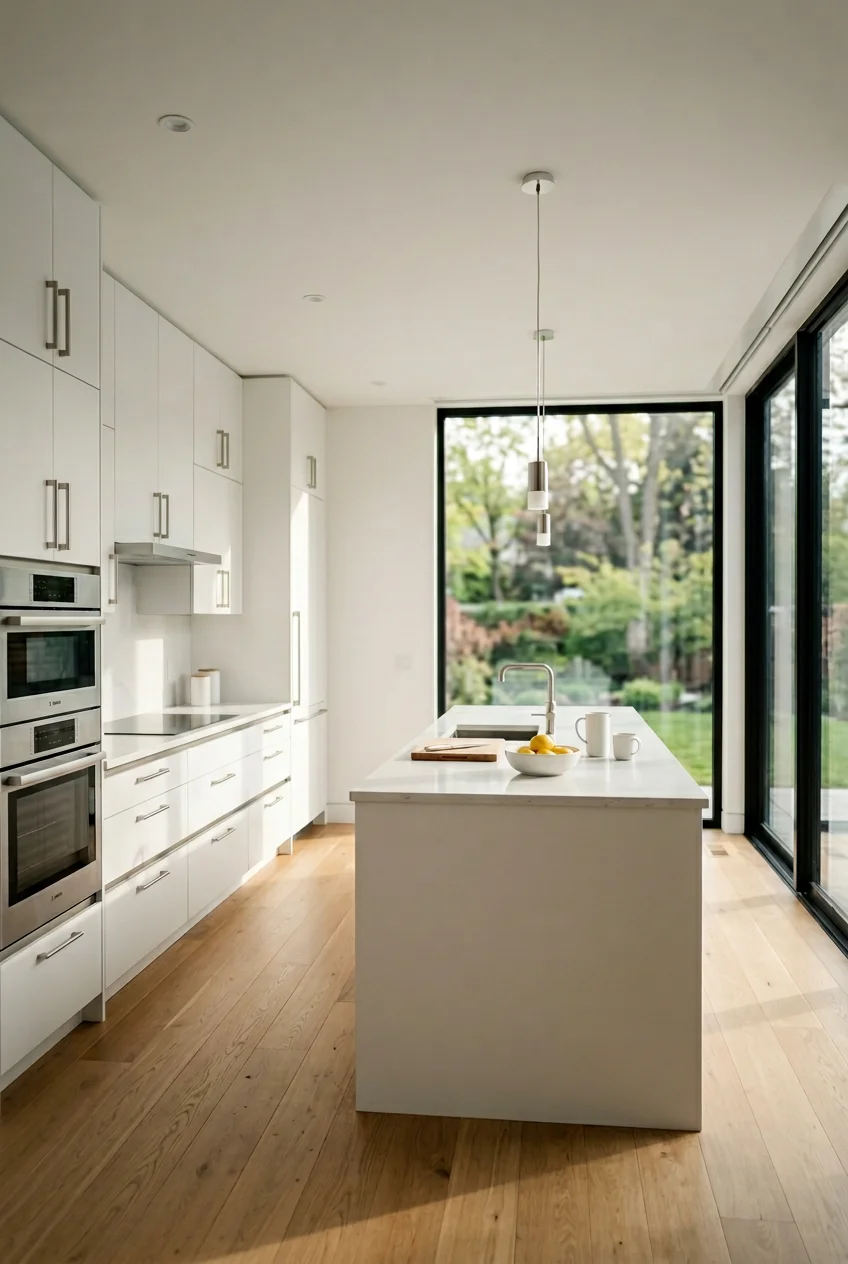
Three years ago, I painted my cabinets a blinding, untinted white. Stepping into the room felt like walking into a dentist’s office for a root canal. A functional white minimalist kitchen isn’t about slapping the brightest paint you can find on every surface. The harsh overhead lights bounced off the glossy finish, creating a glare that gave me a headache while I was chopping vegetables. I spent six months repainting, swapping hardware, and ripping out open shelving that only collected dust. If you’re designing a space from scratch or just trying to fix a sterile-looking rental, you need to understand how light interacts with materials. Let’s look at the specific formulas and products that actually work, rather than the staged magazine photos that hide all the toaster cords.
1. Embrace Warm Whites for a Welcoming White Minimalist Kitchen

When I first tried this, I bought a bucket of untinted base white paint from Walmart for $22. It dried with a blue, icy cast that made my morning coffee routine feel depressing. You need warm whites with subtle yellow, grey, or brown undertones. Sherwin-Williams Alabaster (around $75 per gallon) or Benjamin Moore White Dove are the reliable standards here. I painted my current cabinets in Alabaster last October. The paint has a slight creaminess that softens the hard edges of modern cabinetry, especially when the afternoon sun hits it. Don’t use a stark white on the walls and a warm white on the cabinets. The clash makes the warm white look dirty. I learned that the hard way and had to repaint the drywall. Buy the $6 sample pots and paint a 2-foot square on your wall. Trust me on this.
2. Choose Matte Finishes for Practicality

Glossy cabinets reflect light, which sounds good until you realize they highlight every fingerprint, smudge, and dog nose print. I switched to matte finishes after spending three months constantly wiping down high-gloss acrylic doors. Matte surfaces absorb light, giving the room a softer, grounded texture. It’s a key element for 2026 trends. If you’re upgrading appliances, the Café matte white series is excellent. I bought their 27.8 cubic foot French door refrigerator for $2,900. The finish feels almost like eggshell to the touch and hides water spots perfectly. The downside is that matte surfaces can show oil stains faster than gloss. If you splash olive oil while searing a steak, you have to wipe it with dish soap immediately. Still, the reduction in daily glare makes the maintenance trade-off worth it.
3. Prioritize Handleless Cabinetry

Visual clutter isn’t just about leaving mail on the counter. It’s also about fifty metal drawer pulls sticking out into your line of sight. Handleless or integrated cabinetry creates a flat, uninterrupted plane. German brands like SieMatic do this beautifully, but they cost as much as a car. I used the IKEA SEKTION system with VOXTORP matte white doors. A basic 10×10 layout runs about $2,500. The integrated finger pulls are molded directly into the door face. The negative here is that opening a heavy drawer full of cast iron skillets with just your fingertips takes some getting used to. My grip slipped more than once during the first week. But the lack of protruding hardware means I don’t catch my sweater pockets on knobs anymore while rushing past the island.

Wagensteiger Stainless Steel Curved Garlic Presser or
A dependable everyday pick — Wagensteiger Stainless Steel Curved Garlic Presser or Cheese Grater pulls in 13 ratings at 4.5 stars. Not flashy, just solid.
4. Invest in High-Quality White Quartz for Your White Minimalist Kitchen

Marble looks gorgeous until you leave a lemon slice on it for ten minutes and it etches a permanent cloudy ring into the stone. I ruined a $400 marble pastry slab this way. For a functional white minimalist kitchen, white quartz with subtle veining is the only logical choice. It’s non-porous and doesn’t require annual sealing. Expect to pay between $70 and $100 per square foot for quality material like Caesarstone or Silestone, including installation. I went with a 3-centimeter thick slab with a square eased edge. The thickness gives it a solid, architectural weight. When I spill red wine or turmeric-heavy curry from Trader Joe’s, I just wipe it up with a damp cloth. The only rule is you can’t put a hot pan directly on it. I keep a $15 silicone trivet in the top drawer specifically for baking sheets.
5. Layer Lighting with Warm Bulbs

A single bright overhead light turns a white room into an interrogation cell. You have to layer the lighting. I use ambient ceiling lights, under-cabinet task lighting, and a small accent lamp. The crucial detail is the color temperature. I strictly use bulbs in the 2700K to 3000K range. Anything higher than 3500K casts a blue, artificial hue that makes white cabinets look cheap. I installed Philips Hue smart bulbs ($45 for a two-pack) in my recessed cans. I set them to a warm 2750K and keep them dimmed to 60 percent during dinner. Always install dimmers. A $25 Lutron dimmer switch takes ten minutes to wire and completely alters the mood of the room. The under-cabinet strips I bought from Costco for $39.99 are essential for chopping vegetables without casting shadows over the cutting board.
6. Conceal Clutter with Integrated Appliances

The hidden kitchen trend is dominating 2026 for a reason. Seeing a blender, a toaster, and a coffee maker breaks up the visual flow. I built an appliance garage—a cabinet that sits directly on the counter with a retractable door. Inside, I keep my $130 Ninja blender and a basic kettle plugged in and ready to use. When I pull the door down, the mess disappears. I also recommend panel-ready appliances. I bought a panel-ready Bosch 800 Series dishwasher for $1,300 and attached a custom white cabinet front to it. You literally can’t tell it’s a dishwasher until you pull the handle. The strict unbroken lines of white cabinetry make the room feel twice as large. The only negative is that panel-ready appliances are significantly more expensive than standard stainless steel models. You might also like: 15 Capsule Wardrobe Outfits Worth Trying
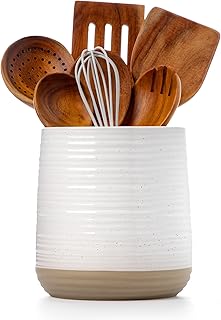
6.8" Large Ceramic Kitchen Utensil Holder
Honestly, 6.8″ Large Ceramic Kitchen Utensil Holder – Utensil Holder for Kitchen surprised me — sturdier than it looks in the photos, and over 194 buyers gave it 4.5 stars.
7. Incorporate Natural Wood Accents

An entirely white room feels unbalanced. You need organic materials to ground the space. I introduce warmth through natural wood elements, specifically walnut and white oak. I bought a massive, 2-inch thick edge-grain walnut cutting board from a local woodworker for $150, but Target sells a decent 14×11 inch version for $24.99. I leave it out permanently on the island. The rich, dark brown wood grain contrasts sharply against the white quartz. I also installed two 36-inch floating shelves made of white oak near the sink. I keep my everyday ceramic plates there. Be careful not to mix too many wood tones. If your floors are red oak, don’t bring in yellow pine accents. Stick to one or two wood species. The wood adds the necessary visual weight so the white cabinets don’t look hollow. You might also like: 19 Work Capsule Wardrobe You Need to See
8. Utilize Smart Internal Drawer Organizers

Minimalism isn’t about throwing everything away. It’s about engineering a place for exactly what you need. Clear countertops require highly functional drawers. I ripped out my standard shelves and installed deep pull-out drawers. Inside, I use Rev-A-Shelf peg systems ($65 per drawer) to hold pots and pans firmly in place so they don’t clang together when I open the drawer. For pantry items, I decant everything. I bought a 10-piece set of OXO POP containers for $55 at Target. I buy steel-cut oats and rice in bulk from Sprouts and pour them directly into the clear bins. Seeing uniform, square containers instead of torn cardboard boxes instantly lowers my stress. The initial decanting process takes an extra ten minutes after grocery shopping, but the visual calm it creates inside the cabinets is worth it. You might also like: 15 Capsule Wardrobe Men That Actually Work
9. Mix Textures, Not Just Shades

If you use matte paint, matte counters, and matte tiles, the room looks like a flat piece of paper. You have to create friction for the eye. I paired my matte white cabinets with a subtle gloss backsplash. I used basic 3×6 inch white subway tiles from Home Depot, which cost about $1.15 per square foot. The cheap price tag doesn’t matter because the glossy glaze reflects the under-cabinet lighting beautifully, contrasting with the flat cabinet doors. I used a warm grey grout (Custom Building Products in the color Natural Gray, $18 a bag) instead of white. White grout turns yellow behind the stove within six months, no matter how much you scrub it. The grey grout highlights the brick pattern and hides splattered tomato sauce. Texture prevents the monochromatic palette from feeling dead.

Kitchen Utensils Set – 34 PCS Non-Stick Silicone Cooking
If you want something that just works, Kitchen Utensils Set – 34 PCS Non-Stick Silicone Cooking Utensils Set is a safe bet (195 reviews, 4.5 stars).
10. Implement the Power of Half Method

You can’t organize too much stuff. Three years ago, I pulled every single item out of my kitchen and put it on the dining table. I boxed up exactly half of it—the duplicate spatulas, the bread maker I used twice, the mismatched coffee mugs. I taped the box shut and put it in the garage. This is the Power of Half method. If I didn’t open the box for three months, I donated it. I ended up keeping my 8-inch Wüsthof chef’s knife ($170) and donating a block of cheap, dull knives. I kept one solid 12-inch cast iron skillet ($25 from Lodge) and ditched three scratched Teflon pans. Living with half the inventory means my cabinets are only 50 percent full. I don’t have to stack bowls precariously. It’s the most effective zero-cost strategy.
11. Clear the Refrigerator Front

This sounds trivial, but it fundamentally shifts the energy of the room. A refrigerator covered in save-the-dates, expired coupons, and souvenir magnets acts as a massive wall of visual static. I used to keep a running grocery list and a calendar on mine. Every time I walked in to get a glass of water, I felt a low-level anxiety about tasks I needed to do. I stripped the fridge completely bare. I moved the calendar to my phone and put the grocery list inside a cabinet door. The difference was immediate. A large, unbroken plane of white metal or custom cabinetry acts as a resting place for the eyes. If you have children’s artwork you want to display, buy a $15 minimal white frame from Target and hang it in the hallway. Keep the kitchen surfaces entirely silent.
12. Design for Unbroken Counter Space

A functional kitchen requires continuous prep zones. When I laid out my current floor plan, I insisted on a minimum of 48 inches of unbroken counter space between the sink and the stove. This is where 90 percent of the actual cooking happens. If you chop this space up with a microwave or a knife block, you ruin the utility and the aesthetic. I moved the microwave to a lower shelf in the pantry. I mounted a magnetic knife strip ($22 on Amazon) to the wall inside a cabinet. Leaving that 48-inch span totally empty means I can roll out pizza dough or line up four cutting boards when meal prepping on Sundays. It gives the room a horizontal expansiveness. When the counters are clear, the white quartz reflects the ambient light perfectly.

Public Goods Kitchen Tool Set | 6 Piece Kitchen Utensil Set
If you want something that just works, Public Goods Kitchen Tool Set | 6 Piece Kitchen Utensil Set | Includes is a safe bet (35 reviews, 4.5 stars).
13. Avoid Over-Accessorizing the Counters

There’s a strong temptation to buy decorative bowls, fake plants, and ceramic roosters to give a white kitchen personality. Don’t do it. Over-accessorizing defeats the purpose of minimalism. Let the architectural materials speak for themselves. I limit my counter decor to items that serve a daily function. I keep a heavy, white marble mortar and pestle ($35 from Williams Sonoma) next to the stove. It looks sculptural but I actually use it to crush peppercorns. I also keep a large glass jar of coarse kosher salt. That’s it. I bought a trendy faux olive tree in a concrete pot last year, placed it on the island, and immediately hated it. It just got in the way when I was unloading groceries from Whole Foods. Keep the horizontal surfaces clear so the room can breathe.
14. Opt for Sleek White Appliances

Stainless steel has been the default for two decades, but it creates dark, heavy blocks that disrupt a white minimalist kitchen. White appliances are returning for 2026, but the designs are vastly improved from the textured, plastic-looking fridges of the 1990s. I look for flat fronts and pocket handles. Brands like Midea and KitchenAid are producing incredibly sleek models. I recently saw a KitchenAid white double wall oven ($3,500) that looked like a piece of modern art. The glass is tinted white, and the handles are minimal brushed brass. If you can’t afford to replace your stainless appliances, you can buy vinyl wrap kits for about $150. I tried wrapping my old dishwasher in matte white vinyl. It took three hours and a heat gun, and while the edges weren’t perfect, it successfully hid the dark metal.
15. Add a Countertop Table Lamp

It’s a 2026 trend that I initially thought was ridiculous until I tried it. Putting a small table lamp on the kitchen counter feels wrong, like bringing living room furniture into a workspace. But the corners of counters under upper cabinets are notoriously dark. I bought a small, cordless LED table lamp with a brass base and a white linen shade from Target’s Threshold line for $35. I put it in the far corner near the coffee station. At 6 AM, before the sun comes up, I turn on just that lamp. The soft, diffused light pooling on the white quartz is incredibly calming. It prevents the harshness of turning on overhead lights when your eyes are barely open. Because it’s cordless, I recharge it via USB once a week. It adds a layer of domestic warmth.

Kitchen Gadgets Set 5 Pieces
Honestly, Kitchen Gadgets Set 5 Pieces surprised me — sturdier than it looks in the photos, and over 49 buyers gave it 4.5 stars.
16. Install Hidden Trash and Recycling Systems

A freestanding stainless steel trash can is an eyesore that ruins the clean lines of a minimalist space. It also takes up valuable floor space. I suffered with a bulky step-can for years before realizing I was wasting a perfectly good lower cabinet. I bought a Simplehuman dual-compartment pull-out trash system for $80. It took twenty minutes to screw the heavy-duty steel tracks into the base of a 15-inch wide cabinet next to the sink. It holds two 30-liter blue and black bins. Now, when I’m scraping plates, I just slide the drawer open with my knee. The trash is completely hidden, and it contains odors better than a freestanding bin. The only negative is that you lose a cabinet that could hold pots, but moving the trash out of the walking path is a mandatory trade-off.
17. Maintain Consistent Metal Finishes

In a white kitchen, the metal hardware acts as the jewelry. If you mix brushed nickel, polished chrome, and unlacquered brass haphazardly, the room looks chaotic. I enforce a strict limit of two metal finishes. My primary metal is brushed brass, which I used for the cabinet pulls and the pendant lights. My secondary metal is stainless steel, dictated by the sink basin. I bought a Kohler Purist pull-down faucet in vibrant brushed moderne brass for $450. The brass warms up the stark white environment. I made the mistake of buying cheap, $4 brass-plated knobs from Amazon for a bathroom once, and the finish rubbed off in six months, leaving a weird pinkish zinc underneath. Buy solid brass hardware. It costs more upfront (around $12 to $15 per pull) but it develops a beautiful patina over time.
18. Ditch the Upper Cabinets Completely

If you want the ultimate minimalist statement, remove the upper cabinets. A solid wall of white boxes can feel oppressive, no matter how clean the design is. When I renovated, I left the wall above the sink entirely bare, painting it the same Sherwin-Williams Alabaster as the lower cabinets. I installed a single, 60-inch long floating shelf made of steel, powder-coated white to blend into the wall. I keep my six daily water glasses and a stack of white bowls there. Without upper cabinets, the room feels ten feet taller. The catch is that you lose 50 percent of your storage space. You have to aggressively declutter to make this work. I store my infrequently used items, like the roasting pan I use twice a year, on a metal rack in the basement. Took me years to figure out that lesson.
19. Commit to a Daily Reset Routine

A white minimalist kitchen is unforgiving. If you leave a dirty coffee spoon on the counter, it becomes the focal point of the entire room. The design demands discipline. I employ a strict 10-minute daily reset before bed. I wipe down the counters with a microfiber cloth and a spray made of half water and half white vinegar. For stubborn coffee rings in the white ceramic sink, I use Bar Keepers Friend ($2.49 at Kroger). I sprinkle a tablespoon, scrub with a damp sponge, and rinse. It removes stains that bleach won’t touch. I load the dishwasher and turn it on, and I put the dish soap bottle back under the sink. Waking up to an entirely blank, clean white kitchen sets a calm baseline for my entire day. The architecture does the heavy lifting, but the daily maintenance keeps the space functional.
Creating a white minimalist kitchen isn’t about stripping away joy or living in a sterile box. It’s about intentionally selecting materials, lighting, and storage solutions that reduce visual friction. I’ve spent years tweaking my own space, and the peace it brings to my daily routines is undeniable. Start small. Clear the front of your fridge today, or box up half your utensils. If you found these strategies helpful, save this guide or pin it for your next renovation project. A calm, functional home is built one deliberate choice at a time.
Frequently Asked Questions
What paint color is best for a white minimalist kitchen?
Avoid untinted base whites, which look blue and sterile. Opt for warm whites with subtle creamy or grey undertones. Sherwin-Williams Alabaster or Benjamin Moore White Dove provide a soft, welcoming glow without looking yellow.
How do I keep a white minimalist kitchen from looking boring?
You have to mix textures and introduce organic materials. Pair matte cabinet finishes with a subtle gloss backsplash tile. Add visual weight by incorporating natural wood accents, like a solid walnut cutting board or white oak floating shelves.
Are matte or glossy cabinets better for minimalism?
Matte cabinets are vastly superior for a modern aesthetic. They absorb light, creating a softer texture, and they hide daily fingerprints and dog nose prints much better than high-gloss acrylic surfaces, which highlight every smudge and scratch.
How do I hide appliances in a white minimalist kitchen?
Utilize appliance garages with retractable doors for small daily items like blenders and toasters. For large appliances, invest in panel-ready refrigerators and dishwashers. You attach custom white cabinet fronts to them, creating a seamless, unbroken wall of cabinetry.
