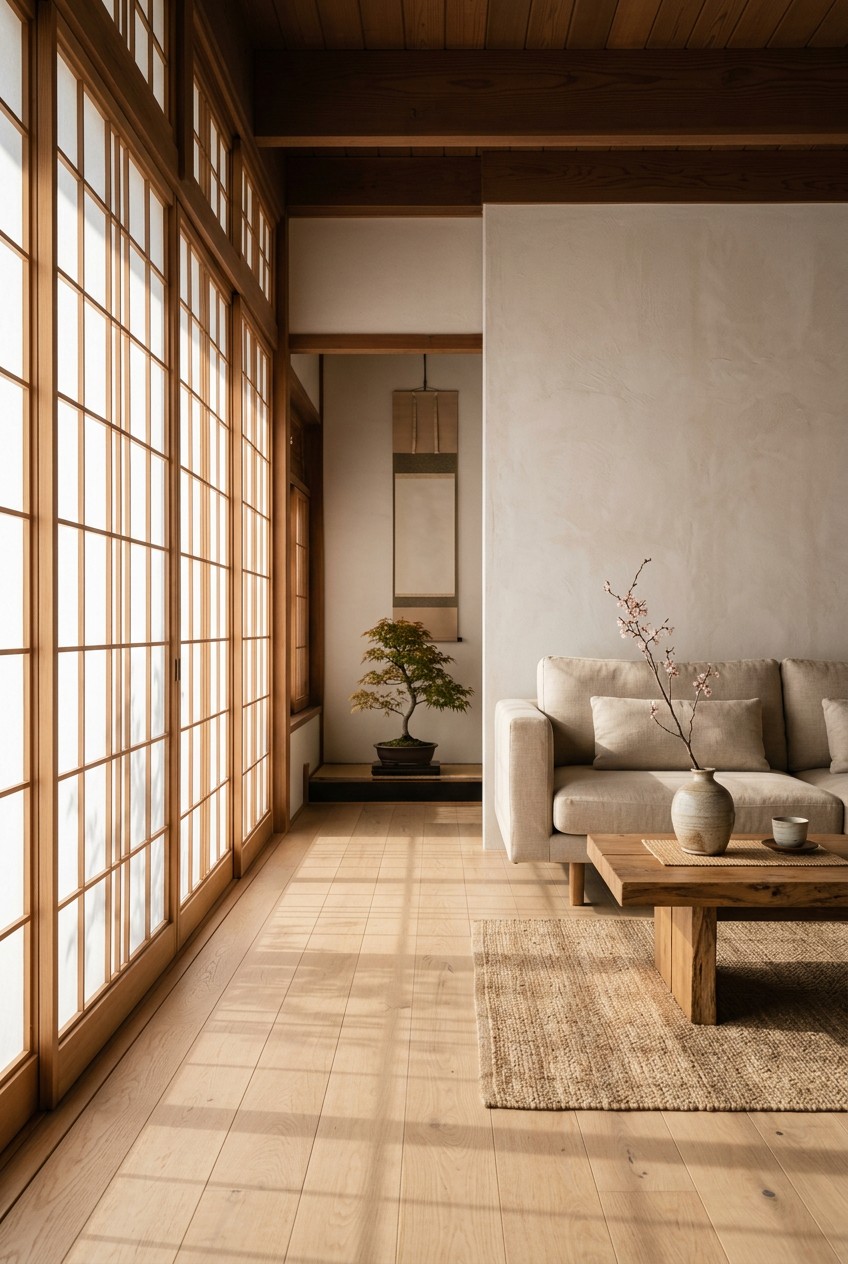
What’s Inside
- Embrace Danshari for a Japanese Minimalist Home
- Cultivate “Ma” with Intentional Empty Space
- Invest in Multi-Functional, Low-Profile Furniture
- Prioritize Natural Materials and Earthy Tones
- Optimize Kitchen Storage with Hidden Solutions
- Integrate Shoji Screens for Diffused Light
- Curate Furnishings Intentionally
- Avoid Visual Clutter in Your Japanese Minimalist Home
- Implement a 10-Minute Nightly Reset
- Choose Subtle, Diffused Lighting
- Incorporate Greenery Thoughtfully
- Prioritize Horizontal Lines in Furniture
- Avoid the Sparse, Cold Environment Mistake
- Embrace the Imperfections of Wabi-Sabi
- Give Every Item a Designated Home
Last winter, I sat on my bedroom floor, crying over a heap of tangled clothes, unread books, and random charging cables. I was suffocating in my own stuff. That was the moment I realized I needed a Japanese minimalist home. I didn’t just want a clean apartment; I wanted a space that felt like an exhale. If you’re tired of managing possessions instead of living, you’re in the right place. A Japanese minimalist home isn’t about tossing everything to sleep on a bare wooden floor. It’s about extreme intention. I’ve spent three years ruthlessly editing my space, making plenty of expensive mistakes. I’ve bought the wrong furniture, painted rooms the wrong colors, and tried hacks that just hid the mess. Let’s skip the trial and error. Here are fifteen specific, actionable ways to bring this calm into your space, no matter your budget.
1. Embrace Danshari for a Japanese Minimalist Home

Instead of shoving things into bins, I learned the Japanese philosophy of Danshari. It means to refuse, dispose, and separate from attachment. I used to buy useless junk constantly. Last Tuesday at Whole Foods, I caught myself staring at a shiny OXO Good Grips Avocado Slicer for $11.99. The rubbery grip was tempting. I almost bought it. Then I stopped. I don’t need a single-use tool when my $149.95 8-inch Shun Classic Chef’s Knife does the job. That’s the ‘refuse’ part of Danshari. You’re blocking clutter at the door. I tried this wrong for months. I’d just buy organizers from Target and cram them full. That isn’t minimalism; it’s organized hoarding. When you declutter, you must dispose of things dragging you down and separate from the guilt of keeping that ugly sweater your aunt gave you. This philosophy forces you to mindfully assess every object. If it doesn’t serve a clear, frequent purpose, it doesn’t get a VIP pass. Skip the impulse buys. They just turn into landfill fodder.
2. Cultivate “Ma” with Intentional Empty Space

Japanese design relies on ‘Ma’, or intentional empty space. It’s the meaningful emptiness between your things. Honestly, the empty space matters as much as the furniture. I used to jam every wall with shelves because I thought bare walls looked unfinished. Big mistake. My apartment felt like a cramped antique shop. If you’ve got a 2-meter wall, don’t shove a 2-meter TV stand against it. I learned this the hard way with a massive credenza I hated. Now, I use a sleek Project 62 Console Table from Target. It costs $130.00 and is exactly 1 meter long. I leave 50 centimeters of pure, empty breathing room on either side. It changes the energy of the room. Your eyes get a break. You aren’t visually exhausted sitting on your couch. Cultivating ‘Ma’ creates mental breathing room. It gives your home an openness you can’t fake with paint. Stop filling every corner. Let your walls breathe. A blank corner is actually encouraged.
3. Invest in Multi-Functional, Low-Profile Furniture

If you want ceilings to feel higher, invest in multi-functional, low-profile furniture. Keeping things low expands your vertical space and feels grounded. I swear by the IKEA ALSEDA Stool. It costs $39.99 and is crafted from textured banana fiber. It smells like dried grass when you unwrap it. It’s 23 5/8 inches in diameter. I use it as extra seating, a footrest, or a makeshift side table for my coffee. Low-profile seating is huge. Brands like Flannel Sofa make incredible low-slung couches that open up a room. A good one runs around $1,200.00, but it changes how you experience your living room. A common mistake is buying massive, overstuffed recliners that swallow the space. Skip the puffy furniture. It looks like a giant marshmallow ate your living room. Stick to clean, low lines. You’ll feel more connected to the earth.

PoKat 23" Modern Ceramic Table Lamp Set of 2 for Living
A dependable everyday pick — PoKat 23″ Modern Ceramic Table Lamp Set of 2 for Living Room White Des pulls in 15 ratings at 4.5 stars. Not flashy, just solid.
4. Prioritize Natural Materials and Earthy Tones

The Wabi-Sabi aesthetic is about finding beauty in imperfection and raw materials. Skip the high-gloss plastic finishes. They look cheap. You want raw wood, stone, clay, linen, and plaster. I’m obsessed with earthy tones like warm greys, deep browns, creamy off-whites, and moss greens. Stark, hospital-white walls aren’t the vibe. Last weekend, I grabbed a $5.99 bundle of dried eucalyptus from Sprouts. The dusty green leaves smell incredible. If you’re ready to invest, look at the Masterwal Wildwood Dining Table. It’s solid walnut that highlights the natural, imperfect grain. It’ll set you back about $2,400.00 for the 72-inch version, but it’s a lifetime piece. I used to buy cheap particleboard tables that chipped after a month. Never again. Bringing natural textures into your home grounds your nervous system. You can feel the difference when you run your hand over real, solid wood. It’s rough, it’s real, and it’s beautiful.
5. Optimize Kitchen Storage with Hidden Solutions

Clear countertops are non-negotiable in a Japanese minimalist kitchen. You can’t cook peacefully staring at a mess of cereal boxes and spice jars. You need hidden and vertical storage. Last month during a Costco run, I finally fixed my pantry disaster. I bought a 9-piece set of OXO Good Grips POP Containers for $59.99. I spent an hour transferring rice, oats, and pasta into these stackable bins. I labeled them with a white paint pen. It looks uniform and clean. For the stuff you can’t hide, use vertical space. I use a Yamazaki Home Cabinet Riser. It costs $22.00, is 15 inches wide, and made of white steel. It doubles my shelf space for mugs and bowls. Most people leave appliances out. Put the toaster away. Put the blender away. Your counters aren’t a storage unit. Keep them bare so you have room to chop a vegetable. You might also like: 15 Inspiring Minimalist Lifestyle Tips That Make a Real Difference
6. Integrate Shoji Screens for Diffused Light

I used to have dark grey blackout curtains. I thought they looked chic, but they made my space a gloomy cave. I was miserable. Then I discovered the magic of traditional Shoji screens. They’re wooden frames covered in washi paper. They provide privacy while letting soft, diffused light filter through. It changes the whole mood. You can use them to cover windows, divide a room, or hide a messy corner. I bought an Oriental Furniture 3-Panel Shoji Screen from Walmart online. It cost $119.99 and stands exactly 71 inches tall. The pine frame smells faintly of sawdust. I use it to separate my sleeping area from my home office. It creates a boundary without blocking the sun. Shoji screens bounce light around and make everything glow. It’s a simple swap that makes a massive difference in how airy your home feels. You might also like: 15 Cozy 2026 Capsule Wardrobe Ideas That Are Totally Worth It

Dog Sculpture Home Decor Cute Man and Dog Statue Decoration
Honestly, Dog Sculpture Home Decor Cute Man and Dog Statue Decoration for Office surprised me — sturdier than it looks in the photos, and over 326 buyers gave it 4.5 stars.
7. Curate Furnishings Intentionally

A massive mistake is throwing out your stuff and keeping a few cheap, flimsy pieces. That isn’t minimalism; that’s a dorm room. You must curate furnishings intentionally, prioritizing quality over quantity. Every item should blend form and function. It needs to be sustainable and well-made. I’m a fan of brands like Maruni Wood Industry. They balance traditional woodworking with modern precision. Their Hiroshima Armchair is a work of art. The curve of the beech wood backrest is flawless. It costs $1,450.00, which is an investment. Or look at the Hirashima Agile Circle Dining Table, which runs about $2,100.00. But here’s the truth: buying one perfect chair that lasts forty years is cheaper than buying a $100 wobbly chair every two years. Save up. Buy the good stuff. Stop filling your home with temporary furniture that ends up on the curb. You might also like: 20 Charming Minimalist Counter Decor Kitchen Ideas That Are Totally Worth It
8. Avoid Visual Clutter in Your Japanese Minimalist Home

Building a beautiful home means aggressively avoiding over-decorating. Resist the urge to fill every blank wall. Too many lines or textures will ruin the serenity. I used to have a massive gallery wall in my hallway with twenty mismatched frames. I thought it looked artsy. In reality, it was just visual noise that stressed me out. I took it all down. Now, I own one large-scale minimalist art piece. It’s a 24×36 inch canvas from West Elm that cost $199.00. It features soft beige and taupe undertones that add warmth without screaming for attention. Next to it, I place a single glass vase with a $6.99 bunch of pink ranunculus from Trader Joe’s. That’s it. Warm minimalism is replacing the cold, clinical look. Keep the clean lines, but ditch the sterile vibe by using warm colors and singular, impactful pieces of art. Let your eyes rest.
9. Implement a 10-Minute Nightly Reset

You can’t maintain a minimalist space without a daily habit. Clutter breeds clutter. If you leave one piece of mail on the counter, there will be a pile of ten by Friday. That’s why I enforce a 10-minute nightly reset. Every night before bed, I spend ten minutes putting away misplaced items, wiping counters, and fluffing pillows. I grab my favorite Mrs. Meyer’s Lemon Surface Spray from Kroger. It costs $4.99 for a 16-ounce bottle. The sharp, clean citrus smell signals to my brain that the day is over. I wipe the sink, put shoes in the closet, and line up the remotes. It prevents the accumulation of junk that eventually overwhelms you. Waking up to a clean, reset home reduces my mental load. I don’t start my morning stressed by yesterday’s mess. Try it tonight. Set a timer and just clean the visible surfaces.

UTTCMK Bookshelf Decor Thinker Statue
If you want something that just works, UTTCMK Bookshelf Decor Thinker Statue – Abstract Art Reading Thinker S is a safe bet (771 reviews, 4.5 stars).
10. Choose Subtle, Diffused Lighting

Harsh, blue-toned overhead lighting has no place in a calming space. If your living room feels like a dentist’s office, you’re doing it wrong. You need subtle, warm, diffused lighting to create a serene atmosphere. Paper lanterns are my favorite. I use the IKEA RISBYN Pendant Lamp in my bedroom. It’s only $39.99 and has a beautiful, organic onion shape. It’s 22 inches in diameter and made of two layers of soft white paper. It gives off an ethereal, gentle glow that relaxes my shoulders. I pair it with a Philips Hue White LED smart bulb for $14.99, so I can dim it to a warm 2700K from my phone. Maximize natural light during the day, but use sheer linen curtains to soften the harsh glare. Stop using those blinding 60-watt daylight bulbs. They’re aggressive. Switch to soft lighting and watch your home turn into a sanctuary.
11. Incorporate Greenery Thoughtfully

Bringing the outdoors inside is crucial, but do it thoughtfully. I see the spa waiting room mistake everywhere: cheap bamboo stalks in a square glass vase with river pebbles. Please don’t do this. It looks tacky. Instead, choose one or two high-quality, intentional plants. I love bonsai trees. Last month, I picked up a stunning Costa Farms Ficus Bonsai from Home Depot. It cost $34.99 and stands about 12 inches tall. I repotted it into a simple, matte black ceramic pot that I found for $14.99. I placed it in the center of my dining table. The dark green leaves and the twisted, thick trunk add life and texture without creating clutter. You don’t need a jungle of fifty dying houseplants. A single, healthy, beautifully potted plant makes a stronger statement and connects you to nature.
12. Prioritize Horizontal Lines in Furniture

Here’s a psychological trick: when your eyes follow a long, unbroken horizontal line, your nervous system receives a signal of safety. It mimics staring at a calm, flat ocean horizon. That’s why you need to prioritize horizontal lines in your furniture. Tall, skinny bookshelves and towering armoires make a room feel frantic. Keep things low and wide. My living room is anchored by an Article Sven Sofa. It’s 72 inches wide, sits low to the ground, and costs $1,299.00. The long, tufted bench seat creates a perfect horizontal plane that calms the room. I also love painting a two-toned wall with a clear horizontal division. I used Behr Blank Canvas paint from Home Depot, which is $34.98 a gallon, on the top half of my hallway, and a soft taupe on the bottom. Ditch the tall, imposing furniture. Go wide, go low, and let your eyes rest on a calm horizon.

seenlast Candle Warmer Lamp with Timer Dimmer Adjustable
seenlast Candle Warmer Lamp with Timer Dimmer Adjustable Height for Ne has been one of the most consistently praised picks in this category. 38 reviewers averaged 4.5/5.
13. Avoid the Sparse, Cold Environment Mistake

The biggest complaint about minimalism is that it looks cold. People think they have to live in an empty white box with a metal chair. That’s the sparse, cold environment mistake, and it’s awful. Japanese minimalism, especially when mixed with the warmth of the Japandi trend, is focused on comfort. You must add soft textures to keep the space inviting. I use the IKEA LOHALS Rug in my living room. It’s a flatwoven natural jute rug that costs $139.00 for the 6’7″ by 9’10” size. The rough, earthy texture warms up the bare wood floors. I also drape a Quince Linen Throw blanket over my sofa. It’s 50×60 inches, costs $49.90, and feels soft against your skin on a chilly evening. These layers of texture—jute, linen, bouclé, wool—prevent the room from feeling like a sterile museum.
14. Embrace the Imperfections of Wabi-Sabi

Stop trying to make your home look like a pristine showroom. It’s exhausting. Instead, embrace the imperfections of Wabi-Sabi in your everyday items. There’s beauty in the natural wear and tear of objects you use daily. A faint crack in your favorite ceramic mug or a scratched wooden table tells a story. It shows that your home is lived in. I use a John Boos Maple Cutting Board every day. It measures 20×15 inches and costs $94.95. When I first bought it, the wood was pale and flawless. Now, after years of chopping and oiling, it has darkened beautifully. It has tiny knife scars all over it. I love those scars. They hold memories of a hundred dinners. This philosophy encourages sustainability because you value items for their character, not for how new they look. Let your leather soften and wrinkle. Let your brass tarnish. Let your home age gracefully with you.
15. Give Every Item a Designated Home

If you want to stop cleaning constantly, give every item a designated home and return it promptly. This is the secret to a serene space. If an object doesn’t have a home, it becomes clutter instantly. I used to lose my phone charger every day. It would migrate from the kitchen to the couch to the bathroom. It drove me insane. Finally, I bought a MUJI Acrylic Storage Box for $18.00. It’s exactly 6×9 inches. I designated one drawer in my console table for electronics. Now, my $14.99 Anker Lightning Cable lives in that box. When I’m done, I coil the cable and put it back. No exceptions. This tiny practice reduces visual noise drastically. You aren’t staring at stray cords, keys, and lip balm scattered across your surfaces. When everything has a home, tidying takes seconds, not hours. Your home will feel calmer, more intentional, and infinitely more peaceful.
Honestly, shifting your space takes time. You won’t fix everything in a weekend, and that’s fine. Start with the ten-minute nightly reset or grab some clear bins on your next Costco run. I recommend picking just one corner of your bedroom to declutter today. Once you feel how peaceful that single empty surface feels, you’ll be hooked. If these tips helped you, please save this post or pin it for later. Your future, less-stressed self will thank you.
Beautiful Decorative Books
Beautiful Decorative Books – Set of 2 Boxes Enhance Your Coffee Table punches above its price — 282 buyers rated it 4.5 stars. I would buy it again.
Frequently Asked Questions
How do I start creating a japanese minimalist home?
Start by adopting the Danshari philosophy. Refuse new unnecessary items, dispose of things that don’t serve a purpose, and separate from emotional attachment to clutter. Focus on one small area, like a single drawer, before tackling entire rooms.
What colors work best for a japanese minimalist home?
Stick to warm, earthy tones inspired by nature. Think soft taupes, muted moss greens, warm greys, and creamy off-whites. Avoid stark, hospital-white walls or overly bright neon colors, as they disrupt the calming, grounded energy of the space.
Is Japanese minimalism expensive to achieve?
It doesn’t have to be. While investing in high-quality, lifetime furniture pieces costs more upfront, you’re buying significantly fewer items overall. You can easily start on a budget by simply decluttering, maximizing empty space, and buying affordable natural textures.
How do I keep my minimalist space from feeling cold?
Incorporate the Wabi-Sabi aesthetic by adding natural, imperfect textures. Use soft linen throws, flatwoven jute rugs, and raw wood furniture. Adding a single, well-potted indoor plant like a bonsai also brings instant warmth and life to the room.
