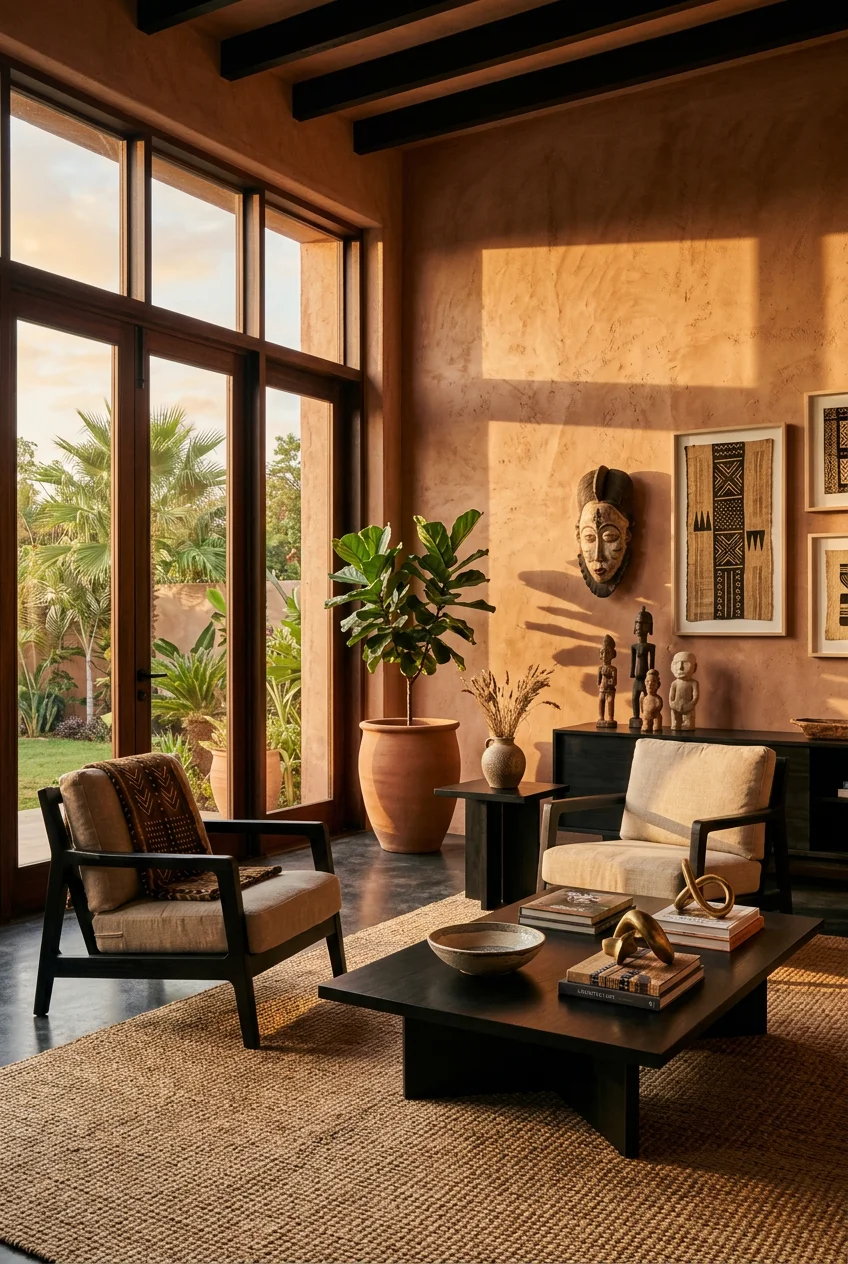
What’s Inside
- Embrace a Warm, Earthy Color Palette as Your Foundation
- Invest in Multi-Functional, Sculptural Furniture
- Incorporate Natural Materials Extensively
- Curate Meaningful African Art and Textiles
- Layer Textures for Depth, Don’t Ignore Them
- Prioritize Intentional Lighting with Warm Tones
- Integrate Greenery with Sculptural Plants
- Avoid Over-Accessorizing; Every Item Must Serve a Purpose
- Use Black as a Grounding Neutral
- Choose Area Rugs That Add Texture and Warmth
- Opt for Open Shelving with Curated Displays
- Don’t Underestimate Scale: Measure Your Space
- Incorporate Geometric and Tribal Patterns Sparingly
- Embrace Imperfection in Handcrafted Items
- Focus on Sustainability and Ethical Sourcing
- Utilize Natural Wood Tones to Warm Up White Walls
- Keep Window Treatments Minimal and Functional
- Introduce Subtle Scents as Invisible Decor
- Conceal Everyday Clutter with Woven Storage
- Leave Intentional Empty Space on Walls and Floors
Two years ago, I stood in my living room holding a mass-produced zebra print pillow from Target, realizing my attempt at afro minimalist decor looked like a cheap theme park. I wanted a space that reflected my heritage without the visual clutter, but I kept buying random tribal prints that completely overwhelmed my 800-square-foot apartment. Afro minimalist decor requires a specific balance of rich cultural textures and strict editing. You can’t just throw a mudcloth on a white sofa and call it a day. After donating five boxes of unnecessary items to Goodwill last October, I finally figured out the formula. I stopped buying cheap acrylics and started focusing on raw, tactile materials. Here’s exactly how I approach it now, including the specific mistakes I made along the way.
1. Embrace a Warm, Earthy Color Palette as Your Foundation

I used to paint everything stark white because I thought that was the only way to do minimalism. It just made my apartment look like a sterile doctor’s office. Now, I use warm neutrals as a base. Last month, I painted my main living room wall in Sahara Sand from Clare Paint. It costs $69 per gallon, which is pricey, but the coverage is dense enough that I only needed one coat. This specific sandy beige mimics natural clay and instantly grounds the room. I picked up a basic trim roller at Walmart for $4.88 to finish the edges. If you use stark white with natural woods, the contrast is too harsh. A warm terracotta or deep brown softens the transition between your walls and your furniture. It’s much easier on the eyes. Trust me on this.
2. Invest in Multi-Functional, Sculptural Furniture

Minimalism fails when you have too many small pieces of furniture cluttering the floor plan. I learned this the hard way when I bought three flimsy side tables instead of one solid piece. Now, I look for items that serve dual purposes and double as art. I bought the Labadi Natural Wood Stool from 54kibo. It retails around $250 depending on the exact carving. It functions as a side table next to my sofa, extra seating when I have guests, and sometimes just a pedestal for a plant. The hand-carved silhouette is striking enough that it doesn’t need decorative objects sitting on top of it. You save space and money when your functional furniture is already visually interesting. I’d rather buy one heavy, carved piece than three cheap metal tables.
3. Incorporate Natural Materials Extensively

Plastic and synthetic acrylics clash violently with the grounded aesthetic of this style. You need materials that actually came from the earth. I swapped my cold metal dining chairs for a rattan barrel chair from DIONE Interiors. It cost $345 and immediately changed the acoustics and warmth of the room. Wood, stone, and woven fibers bring a tactile richness that prevents a sparse room from feeling empty. I also keep a hand-carved 24-inch wooden coffee table in the center of the room. The raw grain of the wood hides dust better than glass, which I appreciate since I hate wiping down tables every single day. I found a great natural beeswax polish at Sprouts for $8.99 to keep the wood hydrated without making it shiny.

KIBAGA Beautiful Bathroom Decor Books
KIBAGA Beautiful Bathroom Decor Books – Set of 2 Modern Books for Your punches above its price — 203 buyers rated it 4.5 stars. I would buy it again.
4. Curate Meaningful African Art and Textiles

Generic abstract art from big-box stores dilutes the cultural impact of your space. I stopped buying random canvas sets and started saving for specific pieces. I recently hung a 24×36 inch framed print of Golden Silhouette Reverie by Sakeem Gibbs. I ordered it from NicheCanvas for $150. The scale is large enough that I don’t need a messy gallery wall around it. Tosin Oshinowo, the founder of ile ila, proves this concept by using Nigerian Aso Oke fabric on simple chair frames. The art does the heavy lifting, so the rest of the room can stay quiet. I bought a basic matte black 24×36 frame at Target for $25 to house the print, keeping the focus entirely on the artwork itself. You won’t regret skipping the gallery wall.
5. Layer Textures for Depth, Don’t Ignore Them

A flat, one-dimensional look is the most common mistake I see in minimalist spaces. When you remove clutter, you have to replace it with texture, or the room feels unfinished. I use a handwoven Ethiopian throw blanket from Bolé Road Textiles. It costs $225 and measures exactly 50 by 70 inches. I drape it over the arm of my neutral linen sofa. The heavy cotton weave adds a subtle shadow and physical weight that smooth fabrics lack. I pair this with a Haislip Mudcloth Pouf, which usually runs about $150 on 54kibo. The coarse texture of the mudcloth against the smooth linen creates friction for the eye. I tried using cheap fleece throws before, but they pill after two washes and look terrible. Stick to heavy, woven cottons.
6. Prioritize Intentional Lighting with Warm Tones

Harsh overhead lighting ruins the mood of any room. I never use the standard flush-mount lights my landlord installed. Instead, I rely on layered lighting with warm 2700K LED bulbs. I installed the Rozeta 34cm Diameter Woven Wall Light from DIONE Interiors. It costs around $180. The woven pattern casts incredible geometric shadows against the wall at night, serving as light and art simultaneously. I supplement this with a simple brass floor lamp tucked into the corner. I buy my 2700K dimmable LED bulbs at Costco in a 12-pack for $14.99. The golden glow makes the natural wood tones in the room look richer. Cool white bulbs wash out terracotta colors and make warm neutrals look dingy and green. Always check the Kelvin rating on your lightbulbs.

Bessol Artificial Eucalyptus Stems in Glass Vase with Faux
If you want something that just works, Bessol Artificial Eucalyptus Stems in Glass Vase with Faux Water is a safe bet (491 reviews, 4.5 stars).
7. Integrate Greenery with Sculptural Plants

Plants are non-negotiable, but you have to choose the right shapes. Bushy, chaotic ferns look messy in a minimalist space. I prefer plants with strong, architectural lines. I bought a 4-foot Fiddle Leaf Fig at Trader Joe’s last Tuesday for just $14.99. I repotted it immediately into a 10-inch terracotta pot from Grounded, a Black-owned plant shop, which cost $35. The stark vertical lines of the plant draw the eye up, making my 8-foot ceilings feel taller. I also keep a Snake Plant (Sansevieria trifasciata) in the bedroom because it requires almost zero maintenance and survives in low light. Just make sure you use a plastic drip tray inside the terracotta pot, or you’ll ruin your wood floors with water stains. I ruined my last apartment’s floors doing exactly that. You might also like: 15 Capsule Wardrobe Outfits Worth Trying
8. Avoid Over-Accessorizing; Every Item Must Serve a Purpose

Christine Platt, author of The Afrominimalist’s Guide to Living With Less, notes that every item should be needed, used, and loved. I used to cover every flat surface with tiny brass elephants and wooden beads. It took me an hour to dust my living room. Now, I limit myself to one or two large, impactful objects per surface. I keep a large 12-inch ceramic bowl from Jade Paton Ceramics on my dining table. It cost $185. I use it to hold fresh fruit or mail, so it actually serves a function. A single large object feels intentional, whereas ten small objects just read as clutter. I donated all my tiny trinkets and haven’t missed them for a single second. Clear surfaces instantly lower your stress levels when you walk in the door. You might also like: 16 Minimalist Colorful Home You Need to See
9. Use Black as a Grounding Neutral

Older minimalist advice tells you to avoid black because it shrinks a room. That’s completely false if you use it correctly. Black adds necessary contrast and grounds floating furniture. I painted the lower cabinets in my kitchen a matte black last spring. I used a $22 quart of rust-oleum cabinet paint from Walmart. It hides scuff marks from my shoes and makes the warm wood open shelving above pop visually. You don’t need to paint a whole wall. Even a matte black ceramic vase or black metal chair legs can anchor a space. Without a touch of black, earthy color palettes can start to look muddy and washed out. The sharp contrast forces the eye to recognize the clean lines of the room. It’s a required element for this style. You might also like: 17 Capsule Wardrobe 2025 Spring That Actually Work

UTTCMK Bookshelf Decor Thinker Statue
If you want something that just works, UTTCMK Bookshelf Decor Thinker Statue – Abstract Art Reading Thinker S is a safe bet (809 reviews, 4.5 stars).
10. Choose Area Rugs That Add Texture and Warmth

Bare floors amplify echoes and make a room feel cold. I always use an area rug to define the living space, especially in open-concept apartments. I layer rugs to get the right mix of comfort and culture. I use a basic 8×10 jute rug as the base, which I got on sale for $120. Over that, I place a smaller 5×7 flat-woven African mat from 54kibo that cost $280. The jute provides coverage and durability, while the patterned mat adds the specific afro minimalist decor element I want. I tried skipping a rug pad once to save money, and the rough jute rug scratched the polyurethane right off my hardwood floors. Always spend the extra $35 on a felt rug pad from Target. It saves your security deposit.
11. Opt for Open Shelving with Curated Displays

Bulky bookcases swallow square footage. I tore out a heavy MDF bookshelf and replaced it with three floating pine shelves. I bought the 36-inch raw pine planks at Home Depot and stained them myself. The total project cost $65. Open shelving forces you to edit your belongings because everything is visible. I only display books I actually reference, a single wooden carving, and a small pothos plant. I wipe the shelves down weekly with a gentle cedarwood cleaner I pick up at Kroger for $4.49. If you pack open shelves full of paperbacks and loose papers, it ruins the minimalist effect immediately. Keep at least thirty percent of the shelf space completely empty to let the objects breathe. Empty space is a design choice.
12. Don’t Underestimate Scale: Measure Your Space

I once bought a massive 90-inch sectional sofa for a tiny 12×12 foot living room. I had to squeeze past it every time I walked to the kitchen. It was an expensive $1,200 mistake. Now, I strictly follow the two-thirds rule. Your sofa should be no more than two-thirds the length of the wall it sits against. If your wall is 120 inches long, your sofa maxes out at 80 inches. I bought a 78-inch linen sofa from Sabai for $1,445, and the proportions are finally correct. The negative space on either side of the furniture is just as important as the furniture itself. Use blue painter’s tape on the floor to map out the exact dimensions before you buy anything online. You can’t eyeball scale.

CEMABT Modern Nordic Boho Vase Set
A dependable everyday pick — CEMABT Modern Nordic Boho Vase Set – Elegant Beige Matte Ceramic Home pulls in 984 ratings at 4.5 stars. Not flashy, just solid.
13. Incorporate Geometric and Tribal Patterns Sparingly

When I first tried this decor style, I bought matching tribal print curtains, rugs, and throw blankets. The room looked chaotic. Afro minimalism requires serious restraint with patterns. I limit myself to one patterned item per room. In my bedroom, everything is solid warm beige or white, except for one Nayali Black and White Lumbar Pillow from 54kibo. It measures 14×20 inches and costs $95. That single geometric pattern stands out beautifully against the solid linen bedding. If you put that same pillow on a patterned rug, it gets lost. Let the pattern act as the focal point. I wash the pillow cover inside out on cold to keep the black dye from fading into the white geometric lines. One strong pattern is always better than five weak ones.
14. Embrace Imperfection in Handcrafted Items

Modern minimalism often relies on perfectly smooth, factory-made surfaces. That approach feels too sterile for me. I prefer pieces that show the human hand. I have a slightly lopsided hand-built ceramic vase on my entryway console. I bought it at a local craft fair for $45. The glaze drips a little on one side, and the rim isn’t perfectly round. Those minor variations in the clay add character that a perfectly symmetrical, mass-produced vase simply lacks. When you have fewer items in a room, the details of those items matter significantly. I stop buying perfectly uniform decor. I want to see the texture of the weave, the knots in the wood, and the fingerprints in the clay. These aren’t defects. They’re the actual design.
15. Focus on Sustainability and Ethical Sourcing

I refuse to fill my home with cheap, disposable decor that ends up in a landfill after six months. Afro minimalism aligns with a nomadic spirit of resourcefulness. I buy fewer things, but I buy better things. I source storage baskets from Goodee, a Black-owned brand that works directly with artisans. I bought a large Ghanaian woven basket for $125 to hold my extra blankets. It is incredibly sturdy and smells faintly of sweetgrass. I also rely on Sabai for sustainable furnishings made from recycled materials. It takes longer to save up for these pieces, but I’ve had that woven basket for three years and it hasn’t frayed once. Cheap plastic bins crack and look terrible anyway. Spend the money upfront and keep the item forever.

Sandstone Resin Thinker Style Abstract Sculpture Statue
A dependable everyday pick — Sandstone Resin Thinker Style Abstract Sculpture Statue Collectible Fi pulls in 13 ratings at 4.5 stars. Not flashy, just solid.
16. Utilize Natural Wood Tones to Warm Up White Walls

If you are renting and can’t paint your stark white walls, you have to compensate with your furniture. I lived in a rental with terrible fluorescent lighting and bright white walls for two years. I warmed it up by bringing in walnut and teak wood tones. I bought a mid-century modern teak sideboard off Facebook Marketplace for $300. The rich, orange-brown tones of the wood instantly neutralized the harsh white paint. I also swapped out the cheap plastic cabinet knobs in the kitchen for 1.5-inch raw oak knobs I found on Etsy for $22 a dozen. It took me ten minutes with a screwdriver, but adding that natural wood element made the generic rental kitchen feel intentional and grounded. Small wood accents fix bad paint jobs.
17. Keep Window Treatments Minimal and Functional

Heavy, dark curtains completely ruin the airy feeling of a minimalist space. I used to have thick velvet blackout curtains in my living room, and they collected dog hair like a magnet. I threw them out and switched to 100% natural linen semi-sheer panels. I bought a set of 84-inch panels from Quince for $89.90. They filter the harsh afternoon sunlight into a soft, diffused glow without blocking the view outside. I hung them on a simple matte black tension rod I grabbed at Walmart for $12.50. The linen fabric has a slub texture that fits perfectly with the natural, earthy aesthetic. If I need privacy at night, I pull down a discreet cellular shade hidden behind the curtain rod. Let the natural light do the work.
18. Introduce Subtle Scents as Invisible Decor

Visuals are only one part of a room’s design. The way a space smells completely alters how you perceive it. I avoid cloying, artificial vanilla or cupcake candles. They give me a headache and clash with an earthy aesthetic. I burn a 7.5 oz Teakwood & Tobacco soy candle from P.F. Candle Co. It costs $24 and lasts for about 40 hours. The scent notes of leather, teak, and orange feel grounded and mature. I buy my matches in bulk at Whole Foods for $2.99 and keep them in a small ceramic cup next to the candle. Scent fills the negative space in a minimalist room without adding any visual clutter to your shelves or tables. It’s the easiest way to finish a room.
19. Conceal Everyday Clutter with Woven Storage

Minimalism doesn’t mean you don’t own ugly things like charging cables and remote controls. It just means you don’t look at them. I use natural woven boxes to hide my daily clutter. I bought a set of three water hyacinth storage baskets at Costco for $24.99. I keep one on the coffee table to hold the TV remotes and coasters. I keep another on my desk to hide my laptop charger and pens. The woven texture adds to the afro minimalist vibe, while the lid keeps the visual noise hidden. I tried using clear acrylic organizers before, but being able to see the tangled cords defeated the entire purpose of putting them away. Stick to opaque, textured storage if you want a calm room. It took me years to figure out.
20. Leave Intentional Empty Space on Walls and Floors

The hardest part of minimalism is learning to stop decorating. I used to feel anxious when I saw an empty corner, so I would buy a cheap floor lamp or a fake plant to fill it. The room ended up feeling suffocating. Now, I protect my empty space. I have a 5-foot stretch of wall in my hallway with absolutely nothing on it. The blank space acts as a visual resting place between the living room art and the bedroom decor. If you fill every single inch of your home, your beautiful, curated pieces have to compete for attention. Let the architecture of the room breathe. The empty space is just as important as the $200 stool or the framed art. Stop trying to fill every void.
I spent years buying the wrong things because I didn’t understand that true minimalist design requires ruthless editing. You don’t need a house full of artifacts to honor your roots. Stick to high-quality natural materials, warm lighting, and a few deeply meaningful pieces. If you’re struggling to start, pick one corner of your living room this weekend and remove everything except the furniture and one piece of art. See how it feels to let the space breathe. Pin this guide for later when you’re standing in a home goods aisle debating whether you actually need that mass-produced vase. You probably don’t. Let’s stick to the pieces that actually matter.
Frequently Asked Questions
What is afro minimalist decor?
It is a design approach that blends the clean, uncluttered lines of minimalism with the rich textures, earthy color palettes, and cultural artifacts of African heritage. It prioritizes meaningful, handcrafted pieces over mass-produced items.
How do I add warmth to a minimalist space?
Swap stark white walls for warm earthy neutrals like sandy beige or terracotta. Incorporate natural materials like raw wood, rattan, and woven textiles to add physical texture and visual weight to the room.
Can I use patterns in afro minimalist decor?
Yes, but strictly limit them. Choose one geometric or tribal pattern per room, such as a single mudcloth lumbar pillow on a solid-colored sofa, to prevent the space from feeling chaotic.
What kind of lighting works best for this style?
Avoid harsh overhead lighting and cool white bulbs. Use layered ambient lighting with warm 2700K LED bulbs. Woven pendant lights and brass floor lamps help cast a warm, golden glow across natural wood furniture.
