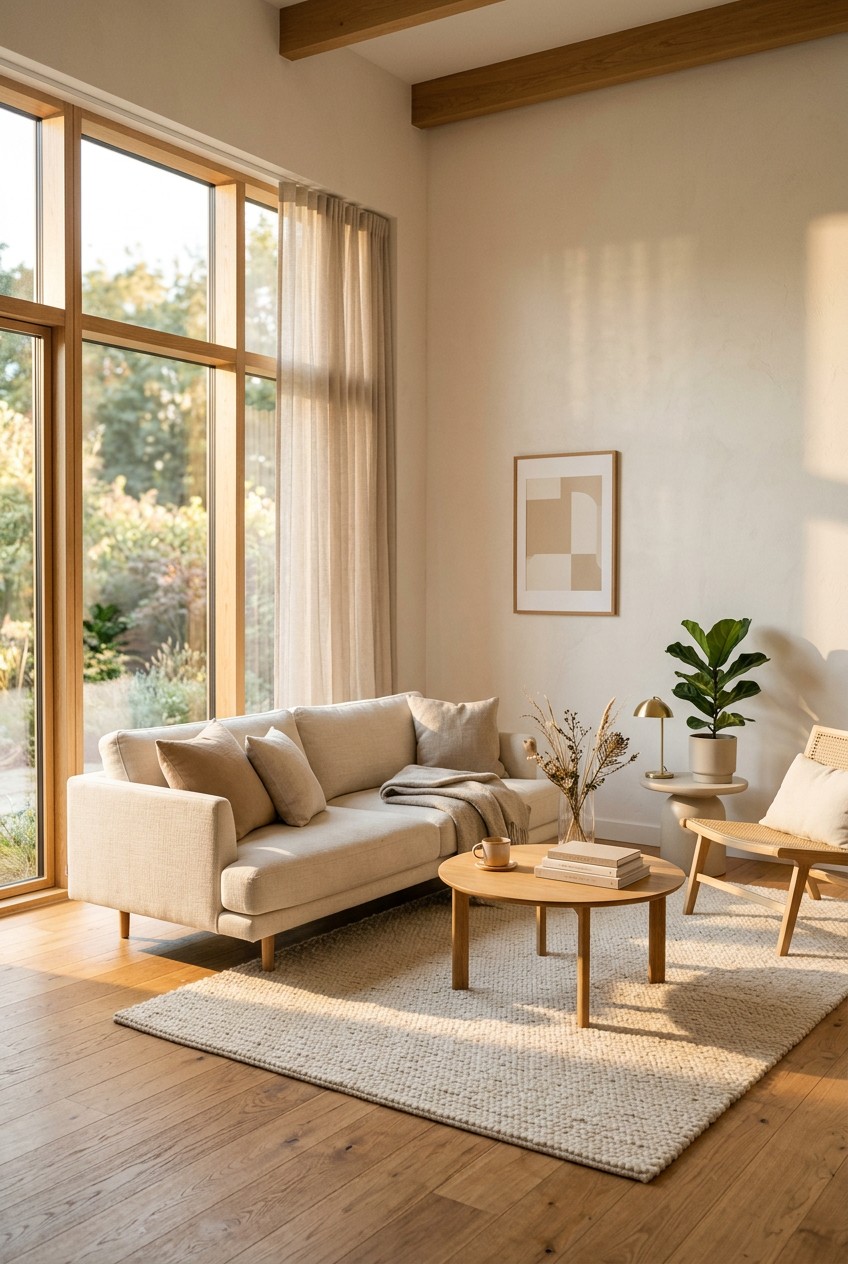
What’s Inside
- Swap Stark White for Warm Neutrals (The Foundation of a Cozy Minimalist Home)
- Layer Textures Instead of Colors
- Pick Multifunctional Furniture With Clean Lines
- Ditch the Overhead Lights for Layered Ambiance
- Curate One or Two Statement Art Pieces
- Go Big With Just One Statement Plant
- Respect the Negative Space Around Your Furniture
- Hide Your Clutter in Plain Sight
- Sink Into Low-Profile, Modular Seating
- Soften the Room With Organic Shapes
- Avoid Furniture That Requires Daily Assembly
- Anchor Your Zones With Thick Wool Rugs
- Display Only Three Meaningful Keepsakes
- Follow the 60/30/10 Color Rule
- Mix High and Low Materials in the Kitchen
- Warm Up Your Bedding With Washed Linen
- Swap Plastic Dispensers for Matte Ceramics
- Use Window Treatments That Actually Let Light In
- Implement the “One In, One Out” Rule Consistently
I spent my first year of “minimalism” sitting in a stark white living room that smelled like fresh paint and felt exactly like a dentist’s waiting area. I wanted a cozy home, but I accidentally built an interrogation room. My friends wouldn’t even take their shoes off because the space felt so cold. It took three years of trial and error to realize that minimal doesn’t mean empty. You can have a space that breathes without it feeling like a hospital ward. I’m going to show you how I fixed my place. Here are nineteen ways to warm up your rooms this weekend.
1. Swap Stark White for Warm Neutrals (The Foundation of a Cozy Minimalist Home)

In 2026, the trend is moving away from stark white and cool grays toward warm minimalism. I used to paint everything pure white. Big mistake. It made my living room look dead, especially on cloudy days when shadows turned a depressing blueish-gray. My walls looked like dirty snow. Now, I stick to earthy neutrals like sand, clay, warm whites, and soft browns. These colors create a serene backdrop and reflect natural light beautifully. Last Tuesday at Whole Foods, I noticed they painted their cafe a soft greige, and it felt so much more inviting. You don’t need a fortune to get this look. I recommend grabbing a gallon of Sherwin Williams Accessible Beige for $35.00 at your local hardware store. Repainting one focal wall in soft beige instead of stark white gives an immediate boost of warmth. It’s the best foundation for your space. Trust me on this.
2. Layer Textures Instead of Colors

To keep minimalist spaces from feeling cold, you’ve got to use a variety of natural textures. This is where most people fail. They buy a sleek leather sofa and a glass table, then wonder why the room feels like a corporate office. I did this for months before I figured it out. You need bouclé sofas, linen curtains, thick wool rugs, rough stone countertops, and matte ceramics. The contrast of rough and soft materials makes a room interesting. For example, a chunky hand-knit throw blanket or nubby wool upholstery adds warmth without adding clutter. I swear by the Target Threshold chunky knit throw blanket. It costs $35.00 for the 50×60 inch size. When you drape that heavy, soft yarn over a smooth chair, the whole room softens. You’re creating depth you can actually feel.
3. Pick Multifunctional Furniture With Clean Lines

Choose furniture that serves more than one purpose to cut down on the total number of pieces. A coffee table with storage, an ottoman that doubles as extra seating, or a desk with hidden compartments are great choices. Look for pieces with clean lines. A big trend right now involves slightly rounded edges to soften the aesthetic. Brands like Castlery offer furniture with raised designs that enhance a sense of openness. I bought the Castlery Andre Coffee Table for $399.00 last year. It has a hidden drawer where I stash my ugly TV remotes and old magazines. Before I had this table, my remotes just sat out, collecting dust and ruining the visual peace of my living room. Now, the surface stays clear. The walnut wood adds a natural element, and the hidden storage keeps my daily mess out of sight.
Beautiful Decorative Books
Honestly, Beautiful Decorative Books – Set of 2 Boxes Enhance Your Coffee Table surprised me — sturdier than it looks in the photos, and over 282 buyers gave it 4.5 stars.
4. Ditch the Overhead Lights for Layered Ambiance

A common mistake is leaving empty space without proper lighting. This makes a room feel terrifyingly stark. I used to rely on my ceiling fan light, and it made me look like a tired zombie every evening. Instead, you need to layer different light sources. Mix ambient, task, and accent lighting. Use warm LED lights (around 3000K to 4000K for living areas) instead of bright white bulbs. I always use dimmers to adjust the mood. You can pick up a 4-pack of GE Relax Soft White LED bulbs for $9.98 at Walmart. Put them in a small, dimmable table lamp. One minimalist creator calls this the “Little Light” theory. It creates a peaceful, golden atmosphere for reading or playing games. When you turn off the harsh overhead fixture and switch on three small lamps around the edges of the room, your space feels like a high-end hotel lounge.
5. Curate One or Two Statement Art Pieces

Minimalist spaces don’t have to be devoid of personality. You just have to be picky. Select one or two statement pieces, like a large painting or an elegant sculpture, to serve as focal points. Display only a few pieces of decor per surface. Think one lamp and a book, or a candle and a single photo frame. Interior designer Abby Pendergrast suggests investing in a chic coffee table book that reflects your interests. This adds personality without visual clutter. I picked up a massive hardcover architecture book at Sprouts (they had a great discount section last Tuesday) for $24.99. It measures 10×12 inches and has a gorgeous matte black cover. I placed it in the center of my coffee table. It gives guests something to flip through, looks intentional, and doesn’t require constant dusting like a collection of tiny figurines.
6. Go Big With Just One Statement Plant

Plants add life and a touch of nature, which is relaxing and can improve your indoor air quality. But instead of cluttering your windowsill with fifteen tiny, half-dead succulents, consider one or two large houseplants. I used to buy tiny plants constantly, and they always ended up looking messy. I killed twelve succulents in one year. Learned that the hard way. Now, I stick to big impact. A snake plant or a pothos are hardy options if you aren’t great at plant care. I bought a 10-inch snake plant from Trader Joe’s for $14.99. The dark green leaves reach almost three feet high. If you want to make it look expensive, Pendergrast recommends Modernica planters for their clean lines. A Modernica Case Study Planter runs about $175.00, but it completely changes the look of a grocery store plant. The smooth ceramic and warm wood stand give the room a structured, earthy vibe. You might also like: 15 Inspiring Minimalist Lifestyle Tips That Make a Real Difference

UTTCMK Bookshelf Decor Thinker Statue
UTTCMK Bookshelf Decor Thinker Statue – Abstract Art Reading Thinker S has been one of the most consistently praised picks in this category. 771 reviewers averaged 4.5/5.
7. Respect the Negative Space Around Your Furniture

A fundamental principle of minimalism is embracing simplicity. A common mistake is filling a room with too much furniture just because you have the square footage. As design expert Adrika from Castlery advises, keep the “less is more” ethos at the top of your mind. Ensure there is breathing room between your furniture pieces. I used to shove my sofa right up against my armchair. It felt claustrophobic. Now, I keep at least thirty inches of empty floor space between every major piece. You can grab a basic measuring tape from IKEA for $1.49 and check your own walkways. When you let the floor show, the room feels twice as big. Your eyes need places to rest. That empty space isn’t wasted space. It’s the thing that makes your home feel peaceful instead of chaotic. You might also like: 15 Charming Minimalist Design Inspiration Kitchen You Can Try Today
8. Hide Your Clutter in Plain Sight

To keep surfaces clear, you must invest in smart storage. This can include storage ottomans, sofas with built-in compartments, floating shelves with baskets, or tall closed cabinets. For kitchens, pull-out drawers and hidden spice racks are excellent for maintaining a sleek look. I hate seeing visual noise. Cords, chargers, and mail drive me crazy. I buy the Brightroom 13-inch fabric storage bins from Target. They cost $10.00 each and fit perfectly into my media console. I throw all my ugly, practical items in there. The outside just looks like a neat row of gray felt. You don’t have to throw away all your stuff to be a minimalist. You just need a designated, opaque home for the things you use every day. If I can’t see the clutter, my brain relaxes. You might also like: 15 Brilliant Minimalist Simple Living Tips That Changed Everything
9. Sink Into Low-Profile, Modular Seating

In 2026, minimalist seating favors low-profile, modular sectionals designed for lounging. This encourages a relaxed, social vibe. It’s great for open-plan spaces. Stiff, formal couches are out. Consider a cloud-style sectional from brands like Povison, which emphasizes deep comfort. I used to have a mid-century modern sofa with hard, skinny cushions. It looked great on Instagram, but it felt like sitting on a wooden bench. I couldn’t stand watching movies on it. I finally saved up and bought a Povison cloud-style modular sofa for $1,299.00. The seats are incredibly deep, and the fabric feels like brushed cotton. Because it sits lower to the ground, it doesn’t block the sightlines across my living room. The room feels taller, and the seating feels more inviting. Always prioritize comfort over a rigid aesthetic.

Dog Sculpture Home Decor Cute Man and Dog Statue Decoration
Dog Sculpture Home Decor Cute Man and Dog Statue Decoration for Office has been one of the most consistently praised picks in this category. 326 reviewers averaged 4.5/5.
10. Soften the Room With Organic Shapes

To add visual interest without excessive ornamentation, opt for furniture and decor with organic shapes and sculptural forms. Boxy, sharp-edged furniture makes a room feel aggressive. You want a rounded coffee table, a curved lamp, or a kidney-shaped mirror. These elements introduce softness, which is a key aspect of warm minimalism. I used to have a square mirror over my entryway table, and it looked harsh. I swapped it for the Umbra Hub oval mirror from Target, which costs $70.00 and measures 24 by 36 inches. The soft, curved black rubber rim changed the whole entryway. It feels fluid and gentle now. Look around your living room. If every single item is a square or rectangle, you need to break it up. Bring in a round ceramic vase or an arched floor lamp. The difference is subtle but effective.
11. Avoid Furniture That Requires Daily Assembly

While multifunctional furniture is generally good, you must be wary of pieces that require daily, cumbersome changes. For example, a bed that folds into a desk every morning. As one expert notes, unless you absolutely need it for a tiny studio, beds that fold into desks are inconvenient. The goal is to reduce hassle, not create a daily chore. I learned this the hard way. I bought a cheap convertible futon for my guest room, thinking it was clever. It was heavy, pinched my fingers every time I folded it, and the mattress felt like a bag of rocks. I eventually threw it out and bought a Zinus 12-inch Green Tea Memory Foam Mattress for $299.00 on a simple metal frame. It doesn’t fold. It just sits there, looking neat and feeling comfortable. Don’t sacrifice your sanity for a clever party trick.
12. Anchor Your Zones With Thick Wool Rugs

In open-plan living, rugs can effectively define different zones, adding necessary softness and warmth. For example, a large wool area rug can anchor a seating area. Place your furniture partly on the rug to maximize floor space and create a sense of expansiveness. A standard living room usually needs an 8×10 foot rug. Don’t buy a tiny rug that floats under your coffee table. It makes the room look cheap. I bought a Safavieh 8×10 wool area rug for $215.00 from Costco. The texture is incredible. Walking barefoot on thick, hand-tufted wool on a cold Tuesday morning is the ultimate luxury. It visually separates my living room from my dining area without needing any walls. Skip the thin, printed synthetic rugs. Invest in real wool. It smells slightly earthy at first, but it lasts forever and feels amazing.

PoKat 23" Modern Ceramic Table Lamp Set of 2 for Living
PoKat 23″ Modern Ceramic Table Lamp Set of 2 for Living Room White Des has been one of the most consistently praised picks in this category. 15 reviewers averaged 4.5/5.
13. Display Only Three Meaningful Keepsakes

Avoid a generic feel by incorporating real personal touches. Display heirlooms, handmade pieces, travel souvenirs, or a few carefully chosen family photos. The key is editing. Highlight just a few important pieces to give them the spotlight they deserve. I used to buy random signs from craft stores. My house looked like a catalog, but it didn’t feel like me. Now, I have exactly three personal items on my living room shelves. One is a piece of driftwood I found on a trip to Oregon. Another is a Framebridge custom 5×7 frame that cost $65.00, holding a photo of my grandparents. When you limit your display items, each one becomes a conversation starter. You aren’t distracted by fifty little trinkets. Your home should tell your story, not a big box store’s story.
14. Follow the 60/30/10 Color Rule

When using a neutral color palette, apply the 60/30/10 rule. This means 60% dominant color, 30% secondary color, and 10% accent color. For example, warm white walls, soft beige furniture, and muted green plants or terracotta accents. This ensures a cohesive look without overwhelming the space. I used to just buy things in whatever color I liked that day. My living room ended up looking like a chaotic thrift store. Now, I stick to the formula. I use Behr Premium Plus Warm White paint ($29.98 per gallon at Home Depot) for my 60% base. My sofa and rug make up the 30% beige. My 10% is strictly matte black metal and dark green plant leaves. It takes the guesswork out of decorating. If an item doesn’t fit the 30% or 10% category, I simply don’t buy it.
15. Mix High and Low Materials in the Kitchen

For kitchens in 2026, soft minimalism is trending hard. This focuses on clever material pairings. An unexpected approach is contrasting polished, professional-grade stainless steel units with artisanal tiles like terracotta or zellige. This high-low mix adds texture, preventing the space from feeling like a commercial kitchen. I used to think everything in a minimalist kitchen had to be sleek white acrylic. It felt so sterile. I recently installed a backsplash using Clé Tile Zellige 2×2 squares, which run about $19.50 per square foot. The tiles are handmade, slightly uneven, and have a beautiful rough texture. Placed next to my cold, shiny stainless steel refrigerator, the contrast is stunning. It brings an earthy, grounded feeling to a room that is usually dominated by hard appliances.

seenlast Candle Warmer Lamp with Timer Dimmer Adjustable
A dependable everyday pick — seenlast Candle Warmer Lamp with Timer Dimmer Adjustable Height for Ne pulls in 38 ratings at 4.5 stars. Not flashy, just solid.
16. Warm Up Your Bedding With Washed Linen

Your bedroom should be a sanctuary. Stiff, perfectly ironed hotel sheets look great in photos, but they feel restrictive. I highly recommend switching to 100% washed European linen. Linen has a natural, slightly rumpled texture that looks inviting. It breathes in the summer and holds warmth in the winter. I bought the Quince European Linen Duvet Cover in a Queen size for $99.90. The first night I slept under it, I was hooked. It has this soft, crinkly texture that feels comforting. Plus, you never have to iron it. The wrinkles are part of the aesthetic. I pair it with simple white cotton sheets and one long lumbar pillow. It keeps the bed looking minimal, but the heavy linen texture makes you want to dive right in and take a nap. No exaggeration.
17. Swap Plastic Dispensers for Matte Ceramics

Nothing ruins a kitchen or bathroom faster than a neon green bottle of dish soap covered in loud logos. It’s visual clutter that stresses you out. I used to leave my branded bottles sitting on the counter. Once I swapped them out, the difference was shocking. I bought a heavy glass and matte silicone soap dispenser from Grove Collaborative for $14.99. Now, I just buy cheap refill bags of dish soap from Kroger for $3.49 and pour it in. The dispenser looks like a piece of modern pottery sitting next to my sink. It takes two seconds to refill, but it improves the entire counter area. Apply this rule to your hand soap, shampoo, and lotion. Removing loud marketing labels is one of the cheapest ways to make your home feel custom and calm.
18. Use Window Treatments That Actually Let Light In

Heavy, dark blackout curtains have no place in a minimalist living room. They suck the life out of the space and make the walls feel heavy. You want natural light pouring in during the day. I made the mistake of buying thick gray velvet curtains because I thought they looked luxurious. They just made the room smell dusty and feel like a cave. I swapped them for H&M Home linen-blend sheer curtains. They cost $34.99 for a two-panel set. I hung the curtain rod as high as possible, right near the ceiling. The sheer white linen diffuses the harsh afternoon sunlight into a soft, glowing ambiance. At night, they provide just enough privacy without blocking out the streetlights. If you need total darkness in your bedroom, that’s fine, but let your living spaces breathe.
19. Implement the “One In, One Out” Rule Consistently

You can’t maintain a cozy minimalist home if you’re constantly bringing new items inside without letting old ones go. Clutter creeps up on you. You buy a new mug, a new pillow, a new stack of magazines. Suddenly, your serene space is packed again. You have to be ruthless. I keep a box of Glad 30-gallon trash bags ($12.49 at Walmart) in my pantry for donations. If I buy a new sweater, an old one goes in the bag. If I buy a new coffee table book, an old piece of decor gets donated. Last month, I bought a new ceramic vase and immediately packed up an old glass one I hadn’t used in a year. It requires discipline, but it ensures your home never crosses the line back to cluttered. It’s the only way to protect your peace long-term.
Creating a cozy minimalist home doesn’t happen overnight. It took me years of buying the wrong things and living in spaces that felt too cold before I found my balance. Start small this weekend. Pick one room, grab a donation bag, and focus on bringing in warm textures and clearing flat surfaces. I promise you’ll feel the mental shift immediately. If you try any of these tips, let me know how it goes. Make sure you save this post to your home decor Pinterest board so you can reference these specific brands and rules later!
Frequently Asked Questions
How do I make my minimalist home feel cozy?
Swap stark white paint for warm earthy neutrals like beige or clay. Layer natural textures like thick wool rugs and crinkly linen curtains, and use warm 3000K LED lamps instead of harsh overhead lighting.
What is warm minimalism?
Warm minimalism shifts away from cold grays and stark whites. It focuses on earthy color palettes, organic rounded furniture shapes, and tactile materials like stone, matte ceramics, and natural wood to create a highly inviting space.
How many plants should a minimalist have?
Instead of cluttering surfaces with dozens of tiny succulents, a cozy minimalist home benefits from one or two large statement plants. A tall snake plant or pothos in a structured ceramic planter provides maximum visual impact with zero clutter.
Can I have color in a minimalist home?
Yes! Follow the 60/30/10 rule. Use a warm neutral for 60% of the room, a secondary soft tone for 30%, and reserve 10% for bold accents like terracotta pottery or dark green plant leaves.
