What’s Inside
- Mastering The Moody Paint Base
- The Velvet Anchor Piece
- Matte Black Lighting Fixtures
- Heavy Linen Window Treatments
- Intentional Dark Botanical Art
- Living Black Houseplants
- Stealth Storage Solutions
- Mixing Cold Stone And Warm Wood
- Avoiding The Over-Ornamentation Trap
- Scent As Invisible Decor
- Strategic Antique Mirror Placement
- Textural Layering In Monochrome
- Archival And Upcycled Furniture
- Jewel Tone Accents Done Right
- Matte Black Ceramic Planters
- Metallic Hardware Contrasts
- Minimalist Bedding With A Dark Edge
- Emotional Design In Dark Spaces
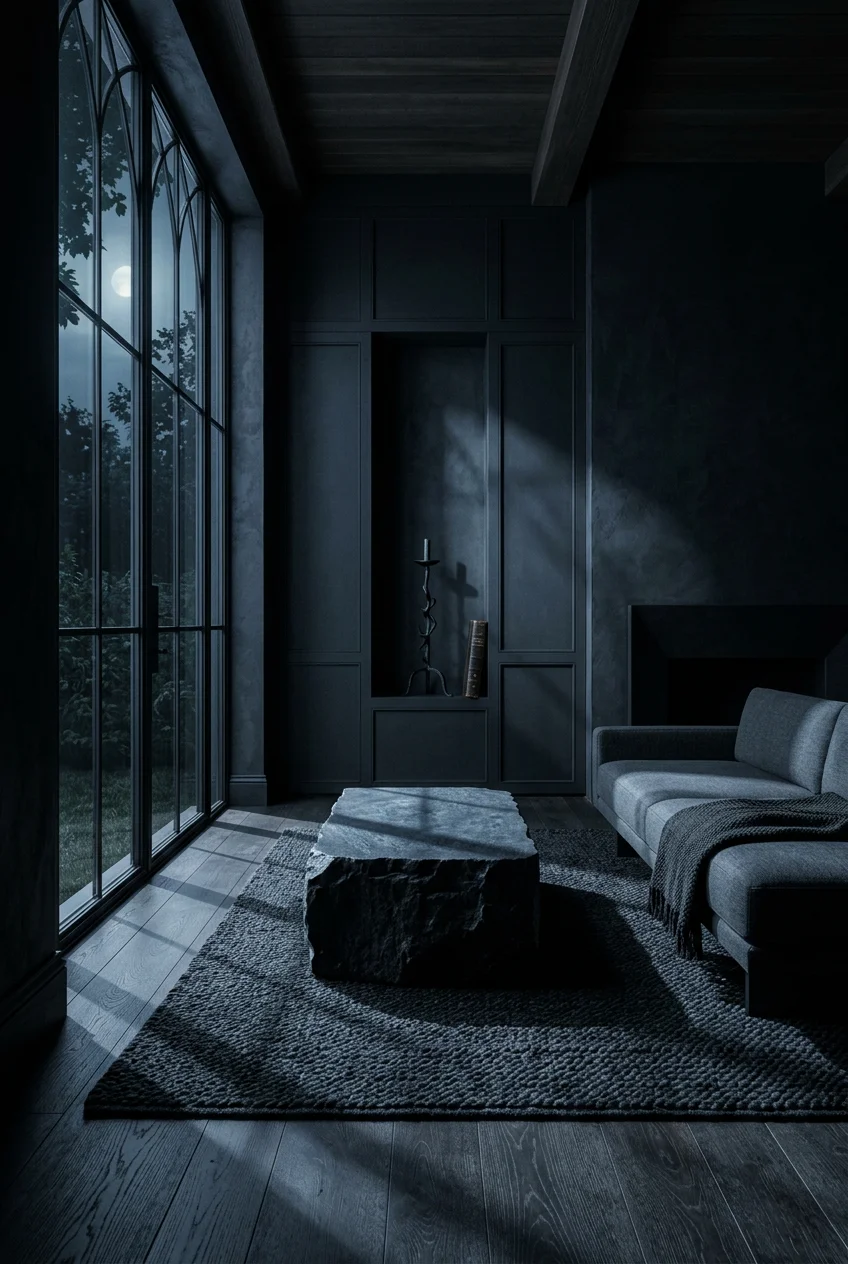
Three years ago, my first attempt at gothic minimalist decor turned my living room into a sterile vampire cave. I painted all four walls flat black using a cheap $25 gallon of paint from Walmart, bought a rigid vinyl sofa, and immediately regretted everything when the space felt like a sensory deprivation tank. I tried this wrong for months before figuring it out. The secret isn’t just buying black things. It’s about light absorption, texture variation, and strict editing. If you’re filling a room with dark tones, the materials have to work twice as hard. Let’s break down exactly how to execute this aesthetic without making your house look like a Halloween pop-up shop.
1. Mastering The Moody Paint Base

When you’re painting walls dark, the light reflectance value (LRV) matters immensely. I learned that the hard way after painting my office a stark black that showed every single drywall flaw and brush stroke. Now, I exclusively use Sherwin-Williams “Iron Ore.” It has an LRV of 6, meaning it’s a deep charcoal that avoids being pitch black. It costs around $75 per gallon. If you want a softer dramatic base, Farrow & Ball’s “Off-Black” works beautifully, though it runs about $130 a gallon. Skip the cheap flat finishes entirely. They scuff if you merely brush against them with a laundry basket. I use an eggshell finish for walls and satin for trim. It reflects just enough light to show the room’s corners so you won’t get that suffocating box effect. If you’re doing an accent wall, prime it gray first. I skipped primer once and had to apply four thick coats of dark paint with a 3/8-inch nap roller just to hide the old beige drywall.
2. The Velvet Anchor Piece

Minimalist rooms require a strong visual anchor. In a dark room, a flat fabric that absorbs light looks dead and uninviting. Velvet solves this by catching ambient light on its pile. I bought the West Elm “Harmony Sofa” in deep charcoal velvet. It costs between $1,800 and $2,500 depending on the exact configuration. The clean lines fit the minimalist requirement, while the heavy fabric provides the necessary gothic weight. I’ve had it for two years now. The back cushions require aggressive fluffing every Tuesday, but the fabric hides dust surprisingly well. Don’t buy a black leather sofa for this look. I tried a cheap leather one first, and it looked like waiting room furniture in an auto body shop. The velvet adds essential friction to the room’s design. It measures 82 inches wide, which fills my living space perfectly without overwhelming the floor plan or blocking the walkways.
3. Matte Black Lighting Fixtures

Lighting dictates exactly how dark paint behaves. You can’t just rely on standard overhead recessed lights. I installed matte black metal fixtures from The Black Steel collection. Their industrial-style pendant lights run between $50 and $300 per fixture. I hung two 12-inch dome pendants directly over my kitchen island. The matte finish prevents cheap-looking glares that ruin the moody atmosphere. Inside them, I use Philips Hue smart bulbs set strictly to warm white (2700K). Cold white light against dark walls looks like a hospital morgue. The 2700K temperature creates a soft, amber glow that warms up the charcoal tones beautifully. I’ve set mine on a timer so they dim to 40 percent capacity after 8 PM. It’s a highly functional setup that directly impacts the room’s atmosphere without adding physical clutter to the tables or floors. The wiring took me about an hour per fixture, but the dramatic shadows they cast are worth the effort.

UTTCMK Bookshelf Decor Thinker Statue
UTTCMK Bookshelf Decor Thinker Statue – Abstract Art Reading Thinker S punches above its price — 835 buyers rated it 4.5 stars. I would buy it again.
4. Heavy Linen Window Treatments

Window treatments are where most people ruin the minimalist aesthetic by adding fussy, unnecessary layers. You don’t need valances, tie-backs, or sheer inner panels. I use heavy linen curtains in charcoal grey from Pottery Barn. They cost $150 per 96-inch panel. The linen has a slubby, organic texture that contrasts nicely against smooth painted walls. I hang them on a simple 1-inch matte black iron rod mounted exactly four inches below the ceiling line. This draws the eye up and makes the room feel taller. I bought a cheaper set at Target once for $35 a panel, but the synthetic blend hung stiffly and wouldn’t drape right at the bottom. The heavy linen actually falls in straight, clean lines. They block light effectively when closed, but I keep them pushed to the far edges of the window frame during the day to maximize natural light against the dark interior.
5. Intentional Dark Botanical Art

Gothic decor easily slips into clutter if you aren’t strictly careful with your art choices. Instead of a gallery wall of tiny frames, I use one massive focal piece. I buy digital prints from Etsy sellers specializing in dark botanical decor. They usually cost around $20 for the high-resolution file. I print a 24 by 36-inch dark floral image on matte paper and frame it in a thin, matte black aluminum frame. The rule for a refined dark color palette is keeping accents under 10 percent and letting whitespace do the heavy lifting. I learned this the hard way after cluttering my hallway with six small frames that just looked chaotic and messy. One large, moody print of a decaying rose or deep purple thistle anchors the wall perfectly. It provides a specific visual interest without demanding too much attention or making the wall feel crowded.
6. Living Black Houseplants

Plants bring necessary organic shapes into rigid minimalist spaces. Instead of standard green pothos, I use plants with deep purple or nearly black foliage. My primary living room plant is a Dark Lord Philodendron. It currently stands 3 feet tall in the corner. You can find them at specialty nurseries for $30 to $100 depending on the pot size. The leaves emerge bright red and harden off to a deep, glossy burgundy that looks almost black in low light. I keep it in a spot that gets bright, indirect light. I kill ferns constantly, but this philodendron only requires exactly 2 cups of water every ten days. I occasionally check the floral section at Trader Joe’s for smaller dark-leafed varieties like burgundy rubber trees. The dark foliage blends with the room’s palette while still adding biological texture. I pot them in a chunky soil mix of orchid bark and perlite for proper drainage. You might also like: 20 Charming Minimalist Counter Decor Kitchen Ideas That Are Totally Worth It

2 Pcs Natural Wood Arch Decor
Honestly, 2 Pcs Natural Wood Arch Decor surprised me — sturdier than it looks in the photos, and over 51 buyers gave it 4.5 stars.
7. Stealth Storage Solutions

Minimalism fails instantly if you have mail, charging cables, and shoes sitting on your dark furniture. Visual clutter is the absolute enemy of this aesthetic. I use the Saatva Halle storage platform bed in my bedroom. It starts around $1,500 for a queen size. The hydraulic lift mechanism reveals a massive storage compartment underneath the mattress. I keep all my out-of-season clothes and spare wool blankets in there. Creating a clean feel requires integrating storage into the existing layout. If you don’t have built-ins, buy furniture that hides your daily mess. I used to keep wire baskets under a standard metal bed frame, but they collected thick dust and looked visually chaotic. The solid base of a storage bed grounds the room and completely eliminates the visual noise of under-bed clutter. It’s a practical constraint that forces you to stay organized and keeps the floor plan completely clear. You might also like: 15 Cozy Minimalist Bedroom Worth Trying
8. Mixing Cold Stone And Warm Wood

If everything in a room is matte black metal, it feels like a mechanic’s garage. You have to mix materials to build depth. In my dining area, I paired a dark walnut wood table with a black quartz sideboard. The quartz has a subtle, cool-toned veining that contrasts beautifully with the warm, open grain of the walnut. I wipe the quartz down daily with a simple vinegar and water solution I mix in a cheap spray bottle from Walmart. The wood requires a beeswax polish every six months to keep it from drying out and cracking. I found a great wrought iron floor lamp at Target for $60 that ties the two materials together perfectly. This combination of cold stone and warm wood provides structural interest without requiring decorative objects. The materials themselves act as the decor. It’s a methodical way to build a gothic atmosphere using purely functional, heavy surfaces. You might also like: 15 Minimalist Goth Home for Every Budget
9. Avoiding The Over-Ornamentation Trap

The most common mistake people make with this aesthetic is conflating gothic with Victorian clutter. You don’t need candelabras, plastic skulls, and lace doilies on every single surface. It’s important to strike a balance so the design doesn’t become overly detailed and exhausting. I spent my first year in this house buying small, dark trinkets. Dusting them took an hour every Saturday. I ended up donating two heavy boxes of decorative objects to Goodwill. Now, my coffee table holds exactly three things. I have a matte black tray, one heavy brass coaster, and a single thick design book. The gothic element comes from the heavy proportions and dark colors of the furniture, not from spooky accessories. Keep the silhouettes laconic and strict. If an item doesn’t serve a daily function or anchor a specific wall, it simply doesn’t belong in the room.

KIBAGA Beautiful Bathroom Decor Books
A dependable everyday pick — KIBAGA Beautiful Bathroom Decor Books – Set of 2 Modern Books for Your pulls in 205 ratings at 4.5 stars. Not flashy, just solid.
10. Scent As Invisible Decor

Atmosphere isn’t just visual. Scent acts as an invisible layer of design that reinforces the mood without taking up physical space. I rely heavily on luxury candles with dark, smoky profiles. My standard is Byredo’s “Bibliothèque.” It has strong notes of patchouli, vanilla, and violet. An 8.5 oz jar costs about $90 and burns for 60 hours. When I don’t want to spend that much, I buy the Le Labo “Santal 26” for $85, which has a distinct leathery scent. I buy basic unscented pillar candles at Whole Foods for actual lighting during dinner, but I use these specific scented candles to change the room’s character. I always trim the wick to a quarter inch to prevent black soot from staining the glass. The heavy, woody scents match the dark visual weight of the charcoal walls and velvet furniture perfectly. It makes the space feel intentional the second you walk inside.
11. Strategic Antique Mirror Placement

Dark rooms absorb natural light aggressively. To counter this, I use a large antique-style mirror with a dark bronze frame. I bought one from Anthropologie for $500. It measures 3 feet by 5 feet. I leaned it against the wall directly opposite my only south-facing window. This bounces the afternoon light back into the room, creating a massive illusion of greater depth. The ornate frame provides a tiny dose of traditional gothic architecture without cluttering the space with small items. Make sure you anchor heavy mirrors to the wall studs. I neglected to do this in my old apartment, and a 40-pound mirror slid on the hardwood floor and shattered completely. Now I use heavy-duty toggle bolt drywall anchors that hold up to 100 pounds. The mirror breaks up the solid dark walls perfectly while serving a highly practical daily function.
12. Textural Layering In Monochrome

When your color palette is strictly limited to blacks and dark grays, texture becomes your primary design tool. A flat black room is boring. A room with black leather, black wool, and black linen is incredibly interesting. I keep a large throw blanket draped over my reading chair. It’s a deep emerald velvet piece from Hommey that costs around $150. I also use heavy wool throws I found at Costco last winter for $30 each. Layering these luxurious fabrics with the sleek finish of metal lamps creates necessary warmth. Without these tactile elements, the space feels unwelcoming and cold. I wash the velvet throw on a cold, delicate cycle once a month to keep the pile soft. The varying textures catch the 2700K lighting differently, creating tiny shadows and highlights that make the monochromatic color scheme look complex rather than flat and lifeless.

Gold Leaf Home Decor Set – Metal Leaves Statues
Gold Leaf Home Decor Set – Metal Leaves Statues has been one of the most consistently praised picks in this category. 61 reviewers averaged 4.5/5.
13. Archival And Upcycled Furniture

The 2026 trend for dark interiors leans heavily into sustainable and archival elements. Instead of buying new, mass-produced black furniture, I look for vintage solid wood pieces and upcycle them. Last October, I bought a beat-up oak dresser from a local estate sale for $40. I sanded it down with 120-grit paper, wiped away the thick wood dust, and applied a matte black penetrating stain. The stain sunk into the heavy wood grain, leaving a beautifully textured, pitch-black surface. It looks far more expensive than a flat-pack MDF dresser. This approach gives you the heavy, imposing silhouettes necessary for gothic design while maintaining the clean lines of minimalism. Plus, older furniture usually features dovetail joints and solid brass hardware that you can clean up with a little Brasso polish. It takes a weekend of manual labor, but the structural integrity is unmatched.
14. Jewel Tone Accents Done Right

A purely black and white room is too high-contrast and modern. To push it into gothic territory, you need deep jewel tones. I don’t paint whole rooms these colors. Instead, I use them in highly specific, controlled doses. Benjamin Moore’s “Wenge AF-180” is a complex, dark chocolate color with distinct purple undertones. I painted the inside of my minimalist bookshelf this color using a small 1/4-inch nap roller. It costs about $80 a gallon. Another excellent option is “Soot 2129-20,” which reads as a dusty, bruised blue-black. I introduced a royal garnet color through two 18-inch throw pillows on the sofa. They provide a striking contrast against the charcoal velvet without overwhelming the strict color palette. It’s a methodical way to add richness. You get the opulent feel of a gothic castle entirely through careful color theory.
15. Matte Black Ceramic Planters

Standard orange terracotta pots completely ruin the sleek look of a dark minimalist room. I repotted all my indoor plants into matte black ceramic planters from CB2. They range from $20 to $80 depending on the diameter. I specifically use these for my Black Velvet Alocasia plants. The matte finish of the pot matches the velvety texture of the plant’s dark leaves perfectly. One major negative I discovered: many sleek modern planters don’t have drainage holes. I killed a $45 Alocasia via root rot because water pooled at the bottom of the sealed ceramic. Now, I use a 1/2-inch masonry drill bit and a trickle of water to add a drainage hole to every ceramic pot before I use it. I buy my liquid indoor plant fertilizer at Sprouts to keep the dark foliage looking sharp and healthy against the dark containers.

Sandstone Resin Thinker Style Abstract Sculpture Statue
Sandstone Resin Thinker Style Abstract Sculpture Statue Collectible Fi has been one of the most consistently praised picks in this category. 13 reviewers averaged 4.5/5.
16. Metallic Hardware Contrasts

Matte black cabinets with matte black hardware look like a black hole. You need metallic accents to define the edges of your furniture. I swapped out the cheap stock handles on my bathroom vanity for heavy, aged brass pulls. The dull gold color pops against the dark wood but doesn’t look shiny or cheap like polished brass. I also use brushed nickel for my kitchen faucet. You can find excellent, heavy-duty aged brass hardware at most hardware stores or even order specialty ones online. I occasionally buy brass aging solutions at Kroger to darken shiny hardware I find on sale. I use a manual Phillips screwdriver to install them so I don’t strip the screws with a power drill. The metallic elements act as jewelry for the room. They catch the ambient light and provide sharp, distinct lines that highlight the minimalist geometry of the space.
17. Minimalist Bedding With A Dark Edge

Your bed is the largest object in your bedroom, so the frame and bedding dictate the room’s entire style. I use the IKEA “Malm” bed frame in the black-brown finish. It costs $299 for a king size. The design is essentially just sharp, right angles. It’s as minimalist as furniture gets. Assembling the wooden slats takes patience, but the frame is rock solid. To make it gothic, I use 100 percent French flax linen sheets in a deep slate gray. I avoid pure black sheets because they show every single piece of lint and look terrible after three washes. The slate gray linen wrinkles naturally, which adds a slightly undone, romantic texture to the rigid bed frame. I wash them weekly in cold water. The combination of the severe, dark bed frame and the heavy, moody linen creates a perfect balance of strictness and comfort.
18. Emotional Design In Dark Spaces

Design discourse for the coming years focuses heavily on emotional design. Minimalist spaces used to be about stripping away personality to achieve a clinical cleanliness. Now, it’s about creating a specific mood. Modern interpretations focus on moody colors and lush materials that embrace drama while remaining highly livable. I want my living room to feel like a quiet, secure cave, not an operating room. The dark colors physically absorb light and sound, creating an acoustic dampening effect that actually lowers my heart rate when I sit on the sofa. The room sounds muffled and calm. If your dark room makes you feel anxious or cold, you haven’t added enough warm textures or ambient lighting. The goal of gothic minimalist decor is to create a space that feels captivating, heavy, and incredibly cozy.
Getting this aesthetic right takes strict discipline. You have to constantly edit out the clutter while ensuring your dark materials are rich enough to carry the room visually. I’ve spent years swapping out cheap flat paints for complex charcoals and trading rigid plastics for heavy linens. The result is a space that feels intentionally dramatic without being exhausting to live in. If you’re planning to darken your space, bookmark this page so you don’t repeat my expensive mistakes. Pin your favorite textures and start with the lighting before you touch a paintbrush.
Frequently Asked Questions
What colors are used in gothic minimalist decor?
The base relies on deep charcoals like Sherwin-Williams Iron Ore or Farrow & Ball Off-Black. Avoid flat pitch black. Accents include rich jewel tones like burgundy, emerald green, and deep midnight blue to add depth without clutter.
How do I keep a dark minimalist room from looking too empty?
Focus on textural layering instead of adding more objects. Mix heavy linen curtains, velvet upholstery, matte black metals, and dark wood grain. These textures catch ambient light differently, providing visual interest without requiring physical trinkets.
What kind of lighting works best for dark painted rooms?
Layered lighting is essential. Use matte black metal fixtures and smart bulbs set strictly to warm white (2700K). Cold white light against dark walls looks clinical. Warm amber light creates the necessary cozy, moody atmosphere.
Which houseplants fit the gothic minimalist aesthetic?
Choose plants with deep purple or nearly black foliage to maintain the moody palette. Dark Lord Philodendrons, Burgundy Rubber Trees, and Black Velvet Alocasias work perfectly. Always pot them in matte black ceramic planters with proper drainage.
