What’s Inside
- Master the 60-30-10 Rule (But Make It Warm)
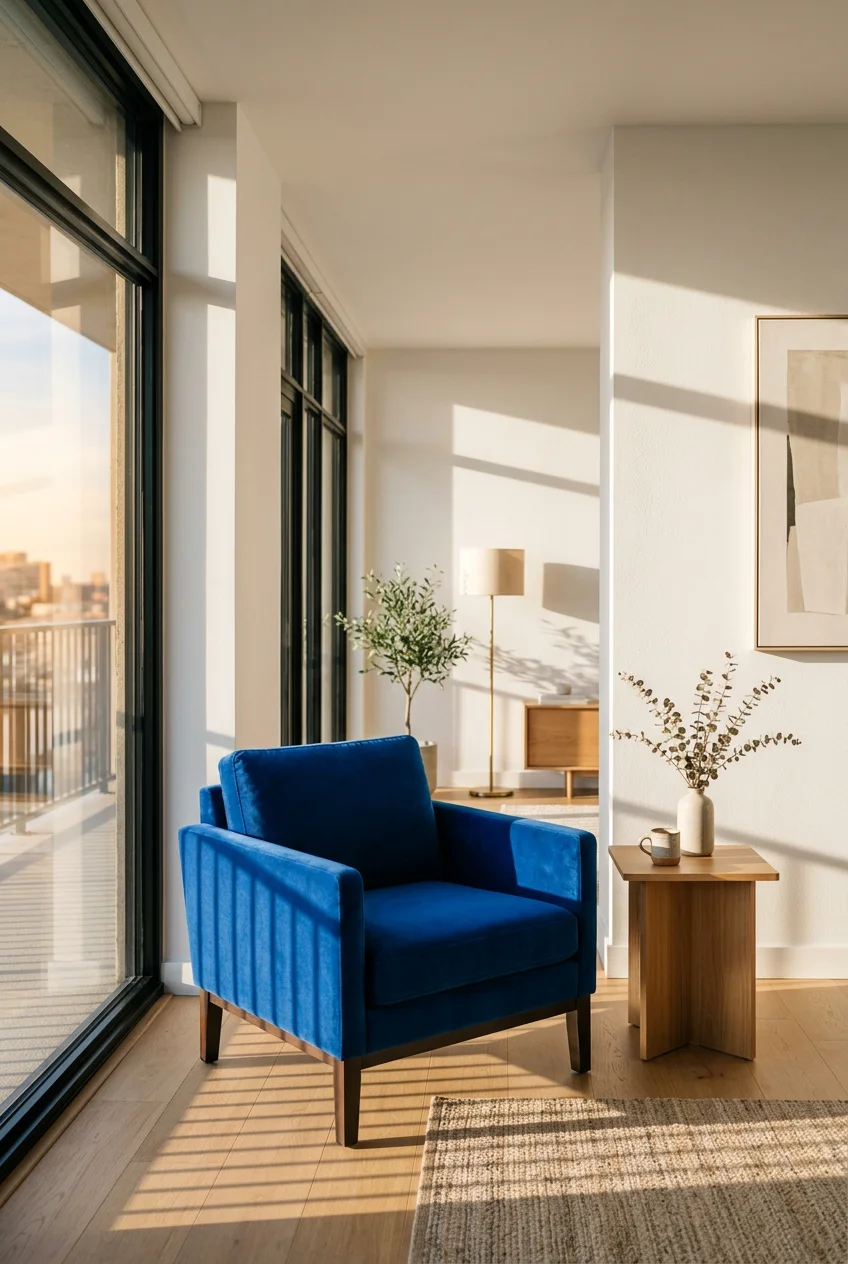
- Anchor the Room With One Statement Sofa
- Swap Stainless Steel for Colorful Appliances
- Curate Art For Your Colorful Minimalist Apartment
- Use Swappable Textiles for Seasonal Color
- Paint Your Interior Doors Instead of Walls
- Ground the Space With Nature-Inspired Hues
- Layer Warm Lighting Through Colored Fixtures
- Hide Clutter Inside Bright Multifunctional Furniture
- Break the Sterile Vibe With Rich Textures
- Stop Matching Everything Perfectly
- Use Colorful Planters for Your Houseplants
- Install Wall-Mounted Storage in Bold Hues
- Match Your Undertones for a Cohesive Look
- Add Intentional Personality With Small Objects
- Swap Hardware For a Colorful Minimalist Apartment Upgrade
- Use Colorful Books as Intentional Decor
- Frame Colorful Postcards for Cheap Wall Art
Three years ago, I sat on a rigid gray sofa in my stark white living room, drinking lukewarm coffee from a clear glass mug, and realized my apartment looked like a dental waiting room. I’d never even considered designing a colorful minimalist apartment back then. I thought color equaled clutter. I tried painting my bedroom a bright teal shortly after that, and it felt like living inside a highlighter. It was a complete disaster. I spent the next 48 hours priming over it while inhaling fumes. You don’t need to live in a sterile white box to be a minimalist. Let’s fix this.
1. Master the 60-30-10 Rule (But Make It Warm)

I painted my entire living room stark white in 2021. It showed every single fingerprint. Now, I use the 60-30-10 color rule. Start with a warm neutral base for 60 percent of the room. I currently use Benjamin Moore’s Universal Khaki in an eggshell finish ($64 per gallon at my local Ace Hardware). It hides scuffs better than pure white. Use a secondary muted tone for 30 percent of the space. I use a soft greige for my curtains and rug. Then, reserve 10 percent for a bold accent color. Interior designer Kristina Phillips is right about avoiding jarring brights against monochrome walls. Layer darker and lighter hues instead. I bought a 16×16 inch burnt orange velvet pillow from Target for $14.99. It sits on my greige sofa and does all the heavy lifting for the room’s color palette. It’s a simple formula. It works. You aren’t required to get a degree in color theory to follow it.
2. Anchor the Room With One Statement Sofa

Scattering tiny colorful knick-knacks creates visual static. I learned that the hard way after buying ten different pastel vases from West Elm on a whim. They just looked like a disorganized yard sale on my bookshelves. Instead, invest in one significant colorful furniture piece. A bright navy couch anchors a room instantly. I bought the Joybird Eliot Sofa in Royale Cobalt velvet for $1,795. It measures exactly 84 inches wide. It fits perfectly against a neutral living room wall. The velvet texture adds depth without requiring extra throw blankets to look finished. The downside is that velvet attracts cat hair like a literal magnet. I keep a $4.99 lint roller from Target in the side table drawer and use it daily. A solid block of color on a large piece of furniture feels intentional. It gives the room a massive focal point. You won’t need to add a dozen smaller colorful items when your sofa does the heavy lifting.
3. Swap Stainless Steel for Colorful Appliances

Stainless steel appliances show every water spot and fingerprint. I spent an hour scrubbing my old fridge with a $6 bottle of Weiman stainless polish, and it still looked streaky in the afternoon light. I eventually gave up. Boldly-colored kitchen appliances fix this problem entirely. I purchased a retro-inspired pastel yellow Smeg refrigerator (model FAB28) for $1,999. It holds 9.22 cubic feet. It acts as the primary art piece in my kitchen. You don’t need decorative counter clutter when your fridge is a giant block of yellow. Samsung also makes customizable Bespoke panels. You can swap out a 4-door flex fridge panel in Clementine Glass for $299. I saw this setup at Home Depot last Tuesday and it looked incredible. The yellow Smeg has a slightly smaller freezer capacity than standard American fridges. I had to stop buying the giant 5-pound bags of frozen broccoli from Costco because they didn’t fit. It forced me to buy fresh produce instead.

Pigort 3 Pieces Metal Flowers Wall Art- Rustic Farmhouse
Pigort 3 Pieces Metal Flowers Wall Art- Rustic Farmhouse Decor Minimal has been one of the most consistently praised picks in this category. 25 reviewers averaged 4.5/5.
4. Curate Art For Your Colorful Minimalist Apartment

Gallery walls are absolute dust traps. I spent three hours leveling a grid of 12 small frames from IKEA, only to realize they made my narrow hallway feel cramped and busy. I took them all down the next morning. For a colorful minimalist apartment, you need one large abstract artwork instead. It creates a powerful focal point without the visual clutter of multiple frames. I found a 36×48 inch abstract canvas print on Etsy for $85. It features deep terracotta and navy brushstrokes. I framed it myself using a $45 DIY floating wood frame kit from Amazon. A single large piece commands attention immediately. Digital downloads on Etsy are even cheaper. You can buy a high-resolution file for $6.99 and print it at Walgreens for $30. Make sure you measure your wall space first with a real tape measure. A piece that’s too small will look like it’s floating aimlessly. A piece that’s too large will completely overwhelm the room.
5. Use Swappable Textiles for Seasonal Color

Committing to a permanent bright color is intimidating. I painted a bookshelf bright coral in 2019 and hated it within a week. Sanding it down took a full Saturday. Now, I introduce color through textiles. They’re entirely non-permanent. Nadia Watts suggests starting with pillows. I keep three 20×20 inch linen pillow covers on rotation. I bought a mustard yellow cover from H&M Home for $12.99. When I get tired of it, I fold it up and store it in a 12×12 inch fabric bin in my closet. I also use a 50×60 inch jewel-toned emerald throw blanket from Crate & Barrel ($49). Textiles soften the hard edges of minimalist furniture. Just don’t buy pillows with non-removable inserts. You can’t wash them easily. They end up smelling like stale air and dust after a few months. Always buy covers with zippers.
6. Paint Your Interior Doors Instead of Walls

Accent walls are a bit dated. They often make a room feel lopsided. I tried one in my office and it just looked like I ran out of white paint. Instead, paint an interior door. It introduces a solid block of color in an unexpected place. I painted the inside of my front door using Sherwin-Williams’ Naval (a deep navy blue) in a satin finish. A quart cost $28 at Lowe’s. I used a 4-inch foam roller to get a smooth finish without brush marks. It took exactly two coats and three hours of drying time. It acts like a tall, vertical piece of art. Interior designer Nicole Cohen also recommends painting ceilings a pale shade. I haven’t tried this yet because my neck hurts just thinking about rolling paint above my head. But a painted door is an easy weekend project. If you mess up, repainting a standard 32×80 inch door takes less than an hour. You might also like: 16 Old Money Capsule Wardrobe for Every Budget

ASTRDECOR Abstract Framed Wall Art
If you want something that just works, ASTRDECOR Abstract Framed Wall Art is a safe bet (251 reviews, 4.5 stars).
7. Ground the Space With Nature-Inspired Hues

Neon colors look cheap in a minimalist space. I bought a hot pink acrylic side table on clearance for $40. It looked like it belonged in a teenager’s bedroom. I donated it two weeks later. Stick to earthy color palettes. Sage green, terracotta, and warm beige connect the space to nature. I painted my bathroom vanity with Little Greene Paint & Paper’s Mid Azure Green. A 1-liter tin cost $52. It completely neutralized the harsh fluorescent lighting in the room. Sherwin-Williams’ Sage Green is another excellent choice for bedrooms. I brought in a 6-inch terracotta planter from a local nursery ($14) and set it on a raw wood stool. The burnt orange clay against the green leaves provides natural contrast. These muted tones don’t fight for your attention. They recede into the background while still providing warmth. You might also like: 15 Soft Summer Wardrobe Capsule That Actually Work
8. Layer Warm Lighting Through Colored Fixtures

Bad lighting ruins good design. I used to rely on a single overhead dome light that made my apartment look like a hospital corridor. It cast terrible shadows. Good lighting is crucial, and colorful fixtures add structural interest even when turned off. I bought a matte rust-orange dome pendant light from AllModern for $114. It measures 12 inches in diameter. I hung it directly over my dining table. It adds a punch of color at eye level. Always use warm LED bulbs. I buy the Philips 2700K dimmable LEDs from Target ($9.99 for a 4-pack). Cold, blue light will wash out any warm colors you’ve added to the room. The orange shade of the pendant light casts a subtle, warm glow on the table. Dusting it is annoying, though. The matte finish grips onto dust particles. I’ve got to wipe it down weekly with a dry microfiber cloth, or it looks dingy. You might also like: 17 Minimalist Home Decor Worth Trying
9. Hide Clutter Inside Bright Multifunctional Furniture

Visual clutter is the enemy of minimalism. If I leave my laptop charger and mail on the counter, my anxiety spikes. Multifunctional furniture solves this. You can hide the mess while adding a pop of color. I bought a round, rust-red velvet storage ottoman from Homary for $159. It’s 18 inches wide and 16 inches tall. I keep my yoga mat, two resistance bands, and a 3-pound dumbbell inside it. When the lid is on, it’s just a stylish, colorful seating option. Brands like Homary blend aesthetics with smart storage. A common mistake is buying storage furniture that requires two hands and a lot of effort to open. If it’s hard to open, you won’t use it. The mess will stay on the floor. My ottoman lid simply lifts off. It takes one second to stash my clutter before someone comes over.

Framed Boho Wall Art Set of 4 for Wooded Minimalist
Framed Boho Wall Art Set of 4 for Wooded Minimalist Botanical Print Wa punches above its price — 956 buyers rated it 4.5 stars. I would buy it again.
10. Break the Sterile Vibe With Rich Textures

A room full of smooth, flat surfaces feels cold. I used to own a glass coffee table, a leather sofa, and vinyl floors. The room echoed when I talked. It felt like an office lobby. You need texture to absorb sound and add warmth. I bought a 5×7 foot hand-tufted wool rug from Rugs USA in a muted plum color for $185. The wool is thick and slightly scratchy, but it completely changed the acoustics of the room. I also added a cream bouclé accent chair. The nubby texture contrasts with the smooth plum rug. The color is subtle, but the texture does the heavy lifting. Avoid synthetic shag rugs. I bought a cheap polyester one from Walmart a few years ago. It matted down into a sticky, gray mess within four months. Stick to natural fibers like wool, cotton, or linen.
11. Stop Matching Everything Perfectly

Buying a matching furniture set is a rookie mistake. I bought a matching bed frame, dresser, and nightstand set from Ashley Furniture in my twenties. My bedroom looked like a catalog showroom. It had zero personality. Expert Kristina of STUDIO KEETA warns against repeating the exact same color combinations everywhere. You don’t need a perfectly matching 3-color scheme. If a color sparks joy, use it. I own a mustard yellow throw pillow next to a pale pink ceramic mug on my coffee table. They technically clash, but they work because they both have warm undertones. Make sure a color shows up at least twice in a space so it feels intentional. I own a small pink art print on the wall that ties back to the pink mug. It’s a relaxed approach to color. It feels collected over time.
12. Use Colorful Planters for Your Houseplants

Plants are the easiest way to add color. But standard plastic nursery pots are ugly. I used to leave my pothos in the green plastic tub it came in. Water leaked onto my windowsill and ruined the paint. I had to scrape and repaint the sill last spring. Now, I use vibrant, minimalist ceramic planters. I found a 6-inch cylindrical ceramic pot in a bright cobalt blue at a local garden center last Thursday for $22. It has a clean, straight edge and a drainage hole. I placed a snake plant inside it. The bright blue contrasts sharply with the dark green leaves. Make sure you buy pots with a matching saucer. I bought a beautiful pastel pink pot from Target for $15, but it didn’t have a saucer. I ruined a wooden side table because I didn’t realize water was seeping through the porous clay bottom.

Sage Green Boho Wall Art Set of 3
Honestly, Sage Green Boho Wall Art Set of 3 surprised me — sturdier than it looks in the photos, and over 907 buyers gave it 4.5 stars.
13. Install Wall-Mounted Storage in Bold Hues

Keeping the floor clear makes a small apartment feel twice as big. I used to own a bulky wooden bookcase that ate up three feet of floor space. I constantly stubbed my toe on it in the dark. I replaced it with a wall-mounted modular system. I chose a String Furniture pocket shelving unit in a bright mustard yellow. It cost $195. It measures 23.6 inches wide and 19.6 inches high. It mounts directly to the drywall. I keep my paperback books and a small trailing plant on it. The yellow metal side panels add a graphic punch of color against my white walls. Wall-mounted storage draws the eye upward. It gives the illusion of higher ceilings. Installation requires a stud finder and a drill. Don’t use cheap drywall anchors. I tried that once with a heavy shelf, and it ripped a hole in my wall at 2 AM. Use heavy-duty toggle bolts.
14. Match Your Undertones for a Cohesive Look

Mixing warm and cool undertones by accident will make your room look slightly off. I couldn’t figure out why my gray sofa looked purple in my living room. It turned out my wall paint had a yellow undertone, which forced the blue undertones in the gray fabric to pull purple. It drove me crazy. Linda of LH. Designs recommends checking your undertones before buying anything. If your existing neutrals are warm (like beige or cream), stick to colors with warm undertones (like terracotta, mustard, or olive green). If your neutrals are cool (like stark white or cool gray), use cool colors (like navy, emerald, or ice blue). I bought a $9 color wheel from Michaels to help me visualize this. I take it with me when I shop for throw blankets at HomeGoods. It saves me from buying things that look great in the store but terrible in my apartment.
15. Add Intentional Personality With Small Objects

Minimalism doesn’t mean living in a sterile void. I took the less is more advice too far a few years ago. I cleared off every single surface in my apartment. My mom came over and asked if I was packing up to move. It felt incredibly uninviting. You have to add intentional personality. I display a small, hand-painted ceramic bowl I bought at a market in Mexico for $12. It sits on my entryway console. I keep my keys in it. It’s functional, but the bright blue and yellow pattern adds instant character. I also keep a vintage brass candlestick holder I found at a thrift store for $4. It sits on my dining table. These small items reflect my life. Limit yourself to three decorative items per surface. Any more than that, and you’re just dusting a collection of knick-knacks.

Wagensteiger Stainless Steel Curved Garlic Presser or
Honestly, Wagensteiger Stainless Steel Curved Garlic Presser or Cheese Grater surprised me — sturdier than it looks in the photos, and over 13 buyers gave it 4.5 stars.
16. Swap Hardware For a Colorful Minimalist Apartment Upgrade

Builder-grade silver cabinet pulls are boring. My rental kitchen had standard brushed nickel hardware that looked completely lifeless. Changing cabinet hardware is the cheapest, fastest way to add color to a minimalist apartment. I bought a pack of 10 matte black and brass geometric knobs from Amazon for $24.99. They have a tiny strip of forest green enamel in the center. I swapped out all the knobs on my bathroom vanity and kitchen cabinets in under 20 minutes. All you need is a Phillips-head screwdriver. It instantly modernized the cabinets. When my lease is up, I’ll just screw the ugly silver ones back on. Keep the old hardware in a Ziploc bag under the sink so you don’t lose them. I lost two screws from my old apartment’s hardware and my landlord charged me $50 out of my security deposit. Never again.
17. Use Colorful Books as Intentional Decor

Books are natural color sources. I used to hide my books in a closed cabinet because I thought the different colored spines looked messy. That was a mistake. Books make a space feel lived-in and intelligent. Now, I use them as decor on my floating shelves. I don’t color-code them into a perfect rainbow. That looks too staged and Pinterest-perfect. Instead, I group 4 or 5 books with similar spine colors together. I stack a bright yellow spine book (like my copy of The Goldfinch) horizontally and place a small $8 concrete coaster on top of it. It breaks up the vertical lines. I bought a heavy, dark green marble bookend from CB2 for $39 to hold up a row of art books. The books provide blocks of color against the white wall. It’s functional storage that doubles as art.
18. Frame Colorful Postcards for Cheap Wall Art

Large art is expensive. If you can’t afford a massive canvas yet, frame postcards. I visited a museum in Chicago last year and bought three oversized 5×7 inch postcards from the gift shop. They featured vibrant Matisse cut-outs. They cost $2.50 each. I bought three 8×10 inch black aluminum frames from Target for $12 each. The frames came with white mats cut for 5×7 photos. I taped the postcards behind the mats and hung them in a vertical line in my narrow bathroom. It cost under $45 total. The bright pinks and blues of the Matisse prints add a huge punch of color to an otherwise boring white bathroom. Make sure you use acid-free tape to secure the postcards. I used standard scotch tape on a print a few years ago, and it turned yellow and ruined the paper within a year. Use drafting tape or proper framing tape.
Creating a colorful minimalist apartment isn’t about abandoning simplicity. It’s about making your space feel like you actually live there. I’m so much happier in my apartment now that it’s not a sterile white box. Start small. Buy a colorful pillow or paint a door. You’ll figure out what works for you. Pin this guide if you need a reminder that minimalism doesn’t have to be boring.
Frequently Asked Questions
How do you add color to a minimalist apartment?
Start with the 60-30-10 rule. Keep 60 percent of the room a warm neutral, 30 percent a secondary muted tone, and use 10 percent for a bold accent color. Use textiles like a 20×20 inch throw pillow or a 5×7 foot textured rug to introduce non-permanent hues.
What are the best colors for a minimalist space?
Earthy, nature-inspired tones work best. Try sage green, terracotta, mustard yellow, or warm beige. I highly recommend Sherwin-Williams’ Sage Green or Benjamin Moore’s Universal Khaki. These muted tones add warmth without fighting for your attention or creating visual clutter.
Can a minimalist apartment be colorful?
Absolutely. A colorful minimalist apartment focuses on intentional color placement rather than overwhelming patterns. You can anchor a room with one statement piece, like a bright navy Joybird sofa, or paint an interior door. It’s about choosing a few bold elements instead of scattering tiny colorful knick-knacks everywhere.
How do you avoid visual clutter when adding color?
Hide everyday items inside bright, multifunctional furniture. I use a rust-red velvet storage ottoman from Homary to stash my workout gear. Also, focus on one large piece of abstract art instead of a busy gallery wall. This provides a strong focal point without making the walls look messy.
